PSTN vs VoIP vs ISDN: Full Comparison for UK Businesses
PSTN uses copper phone lines for voice calls, ISDN sends digital calls over fixed circuits, while VoIP delivers voice through the internet. PSTN and ISDN are being switched off in the UK, whereas VoIP offers lower costs, flexible use, and modern call features.
After helping more than 1,000 UK businesses move from older phone lines to modern systems, we built this guide from the questions firms ask most and the issues we solve daily.
20+ years in UK Telecom | Last updated: December 2025
What is
PSTN
(Public Switched Telephone Network)
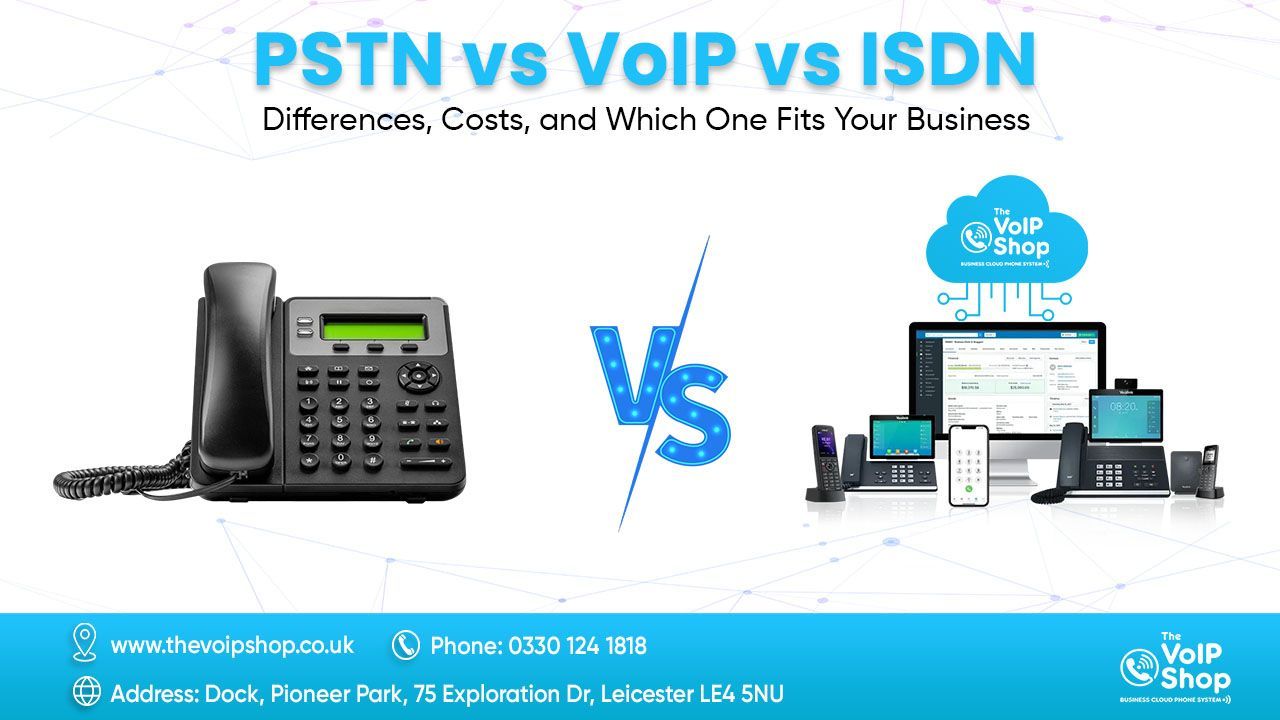
PSTN is a landline network, a traditional phone system that has been in place in the UK for more than a hundred years, using an analogue system telecommunications infrastructure. PSTN provides a method of transmitting voice signals between callers by transmitting electrical impulses over physical copper wires (copper cable) underground.
How PSTN Works
The Public Switched Telephone Network operates through a series of telephone exchanges that create dedicated lines between callers for the duration of each call.
When you dial a number on a PSTN phone, your voice is converted into electrical signals that travel through copper-based technology infrastructure to reach the recipient.
This circuit switching method creates a continuous connection between two points, ensuring consistent call quality but limiting flexibility and requiring substantial physical infrastructure.
Key Characteristics of PSTN
- Uses copper wires and physical phone lines
- Requires network infrastructure of exchanges and switching centres
- Provides power through the line (works during power outages)
- Limited to basic features like voice calls, voicemail, and call waiting
- Location-bound to the physical installation point
- Higher operational costs and maintenance costs
What is
VoIP
(Voice over Internet Protocol)
VoIP represents the modern evolution of telecommunications. Rather than transmitting voice as electrical signals through copper wires, Voice over Internet Protocol converts your voice into digital data packets that travel over your existing internet connection.
How VoIP works
When you talk into a
VoIP phone
or device, your speech is turned into digital data and compressed into little packets. Then, different
VoIP protocols,
such as
SIP
(Session Initiation Protocol), send these packets across the internet to the person who needs them. There, they are put back together and turned back into sound.
With this
packet switching
technology, numerous calls can use the same connection at the same time, which makes it far more efficient than
traditional telephony.
Key characteristics of VoIP
- Uses your broadband connection or internet connection
- Works on multiple devices (desk phones, computers, mobiles)
- Offers advanced features like video calling, call routing, and CRM integration
- Highly mobile – calls can be made from anywhere with internet
- Lower monthly fees and cheaper to scale
- Requires reliable internet stability
- Dependent on the power supply
PSTN vs VoIP Comparison
Based on our 15+ years of experience deploying both systems for UK businesses, here's a comprehensive breakdown of how these technologies compare across various critical factors:
| Feature | PSTN (Traditional System) | VoIP (Modern System) |
|---|---|---|
| Technology | Analogue system using copper wires | Digital system using the internet for voice data transmission |
| Infrastructure | Requires physical phone lines and exchanges | Uses existing internet connection |
| Installation Cost | £50-£150 per line + engineer fees | £0-£50 per user (cloud-based) |
| Monthly Cost | £20-£40 per line | £10-£25 per user |
| Long Distance Calls | High per-minute charges | Often included or minimal cost |
| Scalability | Difficult, requires physical infrastructure changes | Easy, add users via software |
| Mobility | Fixed to a physical location | Access from anywhere with the internet |
| Features | Basic (voice calls, voicemail) | Advanced features (video, routing, analytics, integration capabilities) |
| Call Quality | Consistent on dedicated lines | Excellent with proper bandwidth requirements |
| Reliability | Very high, independent of power | Dependent on internet stability and power |
| Business Tools | Minimal integration | Seamless CRM integration and business tools integration |
| Power Outages | Works during outages | Requires power and internet |
| Maintenance | High, due to ageing infrastructure | Low, only software updates needed |
| Future Support | Being phased out by January 2027 | Current industry standard |
Advantages of VoIP for UK Businesses
Through our work with over 10,000 clients, we've consistently observed these benefits of VoIP:
Significant Cost Savings
VoIP advantages include dramatically reduced costs. Our clients typically save up to 40% on their telecommunications expenses after switching. This comes from:
• Lower monthly fees compared to PSTN
• Minimal or zero long-distance charges
• Reduced maintenance costs
• No need for separate voice and data networks
• Cheaper to scale as you grow
Advanced Features and Functionality
Modern VoIP protocols enable advanced features that would be impossible or prohibitively expensive with PSTN:
• Video calling and conferencing
• Call routing based on time, caller, or availability
• Transcription of Voicemail-to-email
• Auto-attendant and IVR systems
• Call recording and analytics
• Mobile app integration
• Presence indicators signalling colleague availability
• Integration with CRM, email, and business tools
Flexibility and Mobility
Unlike location-bound traditional phone systems, VoIP supports modern working practices:
• Make and receive calls from anywhere with internet
• Use the same number on desk phone, computer, and mobile
• Easy remote access for distributed teams
• Hot-desking support
• Seamless office relocation without number changes
Easy Scalability
Adding capacity to PSTN requires physical installation. With VoIP, scalability is instant:
• Add or remove users within minutes
• No engineer visits required
• Pay only for what you use
• Adjust capacity seasonally without infrastructure changes
Business Continuity
Cloud-based systems offer superior disaster recovery:
• Automatic failover to mobile devices
• Geographic redundancy
• No single point of failure
• Quick recovery from disruptions
Disadvantages of VoIP
While we strongly advocate for VoIP based on our experience, it's important to acknowledge potential challenges:
VoIP depends on internet
VoIP reliability depends entirely on your internet connection. Poor internet stability causes:
• Dropped calls
• Audio quality issues
• Conversations that are late or cut off
Solution: Make sure there is enough bandwidth (at least 100kbps per call) and set up Quality of Service (QoS) settings to give voice traffic priority.
VoIP needs electricity (Risk of Power Outages)
VoIP needs local electricity, but PSTN gets its power through the line:
• The system stops when the power outages.
• Important for firms that need to be open all the time
• Issues with getting to emergency services
Solution: Set up mobile failover options and install Uninterruptible Power Supply (UPS) units.
VoIP has Limitations for Emergency Services
Traditional 999 calls from VoIP may not automatically transmit location data:
• Emergency operators may not know your address
• Critical for businesses across multiple sites
Solution: Ensure your VoIP provider supports E911/ELIN services and registers locations for all devices.
Advantages of PSTN
Despite being phased out, traditional telephony does offer some benefits:
PSTN has Proven Reliability
PSTN's dedicated lines provide:
• Consistent service quality
• Independence from internet issues
• Decades of proven performance
• Function during power outages (corded phones)
PSTN is known for Simplicity
For basic needs, PSTN offers straightforward operation:
• Pick up and dial – no configuration
• Familiar to all users
• No technical knowledge required
• No dependency on IT infrastructure
PSTN is effective for Emergency Services
Location data is automatically transmitted with 999 calls, ensuring rapid emergency response.
Disadvantages of PSTN
Our experience helping thousands of businesses migrate away from PSTN has highlighted significant PSTN limitations:
High Ongoing Costs
Operational costs include:
• Expensive monthly fees per line
• High charges for long-distance calls
• Costly capacity increases
• Expensive maintenance of ageing infrastructure
Limited Features
Basic features restrict business efficiency:
• No video calling
• Limited voicemail capabilities
• No integration with modern business tools
• Basic or non-existent call analytics
• No mobile integration
Inflexibility
Physical infrastructure constraints include:
• Fixed to one physical location
• Weeks required to add capacity
• Engineer visits for any changes
• Expensive office moves
• No support for remote working
Obsolete Technology
The fundamental issue: PSTN phase-out is happening regardless:
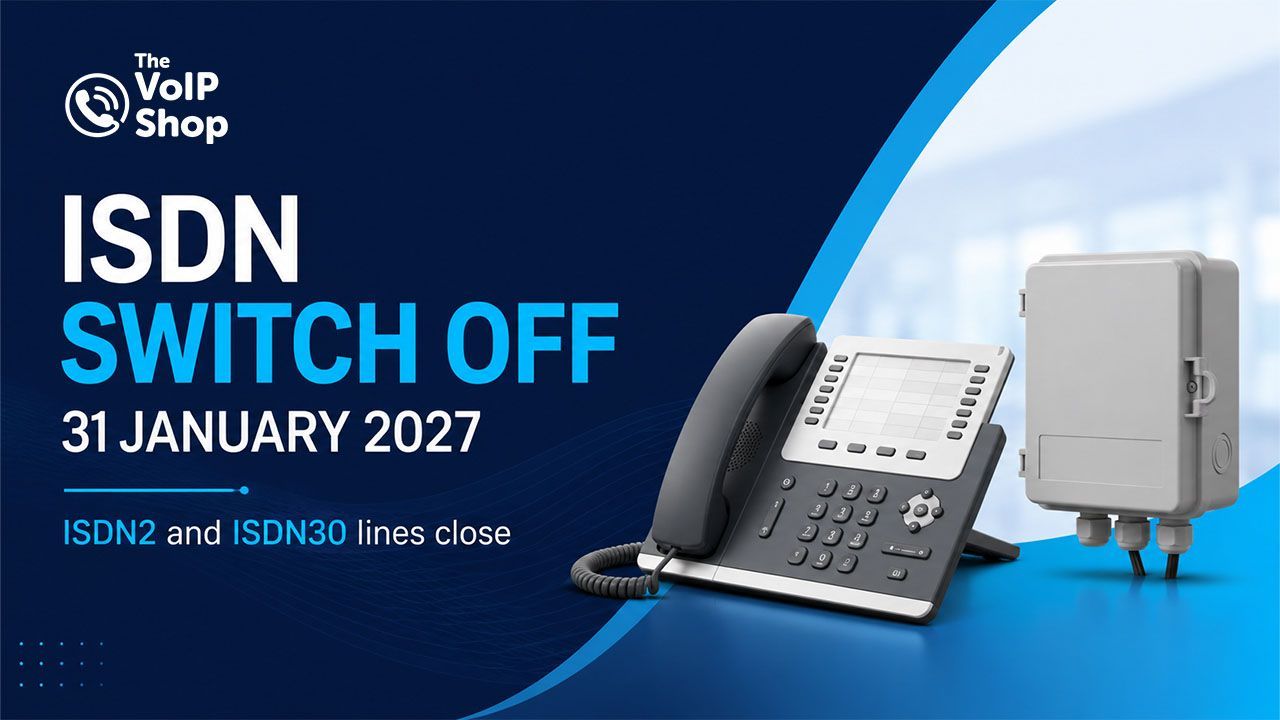
• UK switching to VoIP mandatorily by January 2027
• Increasingly difficult maintenance due to parts scarcity
• Growing unreliability of ageing copper network
• No future investment or improvements
Learn more about the PSTN switch-off timeline.
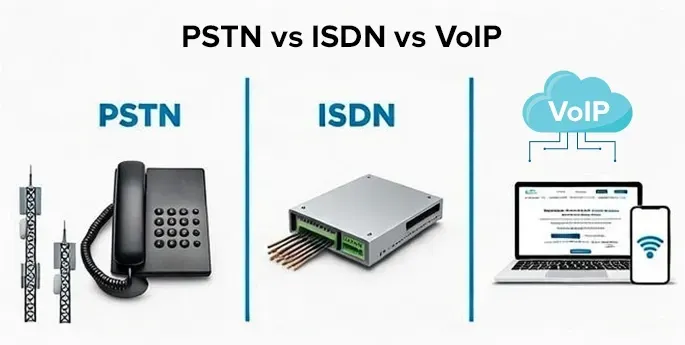
PSTN vs ISDN vs VoIP: Full Comparison
Many UK businesses also use ISDN (Integrated Services Digital Network), a digital evolution of PSTN that still uses physical phone lines but offers better quality and more channels.
| Aspect | PSTN | ISDN | VoIP |
|---|---|---|---|
| Technology | Analogue | Digital over copper | Digital over the internet |
| Data Transmission | Slow | Faster than PSTN | Fastest |
| Channels per Line | 1 | 2 (ISDN2e) or 30 (ISDN30) | Unlimited |
| Call Quality | Variable | Good | Excellent |
| Cost | Moderate | High | Low |
| Future | Ending Jan 2027 | Ending Jan 2027 | Current standard |
Both PSTN and ISDN are being switched off simultaneously. If you're using either technology, you must migrate to VoIP before the deadline.
Which Phone System Is Right for Your Business?
Based on our 15+ years of helping UK businesses with telecommunication solutions, here's our honest assessment:
Choose VoIP If You:
- Need cost-effective telecommunications
- Require advanced features and business tools integration
- Support remote or hybrid working
- Want scalability and flexibility
- Need to comply with the 2027 switch-off
- Have a reliable broadband connection
- Want to future-proof your communications
Verdict: This applies to 95%+ of UK businesses.
Stick with PSTN Only If You:
- Have fewer than 12 months until forced migration
- Have extremely limited internet access (rare in 2025)
- Require specific legacy equipment compatibility
Important: Even in these scenarios, you must plan your VoIP migration immediately due to the January 2027 deadline.
The Reality: VoIP Is Now Mandatory
The PSTN vs VoIP debate has effectively been settled by regulation. With the BT landline switchover mandated for January 31, 2027, every UK business must switch to VoIP regardless of preference.
Our recommendation, based on managing thousands of migrations: act now rather than waiting until 2026. Early movers benefit from:
- Better pricing before demand peaks
- More provider capacity for quality installation
- Time to test and optimise your system
- Avoiding the last-minute rush
- Learning curve spread over time
How to Migrate from PSTN/ISDN to VoIP Successfully: Our Proven 6-Step Process
Drawing on our extensive migration experience, we've developed a proven methodology to ensure seamless transitions from PSTN/ISDN to VoIP. Our comprehensive migration plan ensures zero downtime and beats the BT switch-off deadline in January 2027. Here's our proven process:
Step 1
Check Current PSTN or ISDN Lines
At The VoIP Shop, we audit your telecom supplier invoices to identify all BT WLR PSTN and ISDN lines, documenting line types, services, care levels, and active broadband packages across your estate.
Step 2
Check Current Phone System, PBX and Handsets
We assess your existing phone system, PBX, and handsets, identifying specialty equipment like fax machines, alarm systems, and card terminals. You receive a detailed report with recommendations for migrating to Digital Voice and Fully Hosted Cloud VoIP Phone Systems, followed by a consultation to discuss your personalised migration strategy.
Step 3
Check Current Broadband, Speed and Router
We verify you have stable fibre broadband connection with adequate bandwidth (minimum 100kbps per concurrent call), test router capability, and recommend QoS settings or fibre upgrades if needed.
Step 4
Provide a Comprehensive Migration Plan
Our VoIP Specialists create your tailored roadmap, including transition timelines, a Fully Hosted Cloud VoIP Phone System proposal, power resilience planning (UPS units and mobile failover), number portability to keep your existing numbers, and transparent pricing.
Step 5
Pick Your Migration and Number Port Date
Choose a quiet trading day at least ten to fifteen working days ahead. We configure your new system, ship pre-configured VoIP handsets, and provide on-site engineer installation if required. On Go-Live day, handsets are plugged in, test calls made, and once numbers are ported, your migration is complete with zero downtime.
Step 6
Cancel Old PSTN or ISDN Lines
Cancel your old PSTN or ISDN lines and legacy phone system with your previous provider. You've now beaten the January 2027 shutdown with a future-proof Digital Voice and Fully Hosted Cloud VoIP Phone System.
Future-Proof Your Business Communications
The telephone system migration from PSTN to VoIP represents more than regulatory compliance; it's an opportunity to modernise communications and gain a competitive advantage through digital transformation.
Our 15 years of serving UK businesses have proven that organisations embracing this change early reap the benefits of VoIP while those delaying face unnecessary stress, higher costs, and operational risks.
Get Expert Support for PSTN to VoIP Migration from The VoIP Shop
With over a decade and a half of VoIP industry experience and more than 10,000 satisfied clients across the UK, The VoIP Shop provides:
- Free consultation and site surveys
- Comprehensive migration planning
- Professional installation and configuration
- Staff training and documentation
- 24/7 Ongoing technical support
- UK-based expert team
Don't risk being caught unprepared by the BT switch-off deadline. Contact our team today for your free, no-obligation consultation.
Frequently Asked Questions about PSTN vs ISDN vs VoIP
Is VoIP More Beneficial Than PSTN for Business Use?
Unquestionably yes, according to our 15+ years of experience delivering both systems, VoIP provides more cost-effective options and scalability to add advanced features as your business grows, as well as mobility, than PSTN does. As the traditional phone system will be shut down in January 2027, VoIP is not only better but required!
What will happen to my PSTN phone line after January 2027?
Your PSTN phone will stop working. The copper network will be completely disconnected. All voice calls will need to be made on either VoIP or mobile phones.
Can I use my existing phone number when switching to VoIP?
Yes, number portability determines that you will keep your current business phone number when you’re switching to VoIP; this will ensure continuity for your customers.
What is the cost difference between VoIP and PSTN?
A major difference between VoIP and PSTN is price; VoIP is usually 30% to 50% cheaper than a traditional phone system. While PSTN charges approximately £20 - £40 per line per month, VoIP charges approximately £10 - £25 per user per month and includes additional advanced features.
Will VoIP work during power cuts?
Unlike PSTN, which receives power through the line, VoIP requires local electricity. However, UPS units provide backup power, and calls can automatically fail over to mobile devices during outages.
Do I need special equipment for VoIP?
You can use IP phones (like traditional desk phones), softphones (computer applications), or mobile apps. Many businesses use a combination. Your existing computers and smartphones can function as VoIP devices.