

UK PSTN Switch Off 2027: Business Guide
The big switch off is transforming the UK's telecommunications industry as BT Openreach moves to shut down the country's ageing analogue telephone network by January 2027. This nationwide transition affects every business and household currently using traditional PSTN (Public Switched Telephone Network) or ISDN (Integrated Services Digital Network) services.
At The VoIP Shop, we understand the urgency and complexity of this ISDN switch-off UK transition. Businesses that are still reliant on fixed landlines for communication will be affected, and without proper preparation, you risk significant operational disruption. This comprehensive guide explains what the big switch off means for businesses, outlines critical deadlines, and provides a clear pathway to future-proof digital phone lines.
Download our free ebook: The Ultimate Guide to the BT Landline Switch Off January 2027 to get expert insights on navigating this transition successfully.
last updated 29th September 2026
Switch off guides
Openreach is closing the analogue network on 31 January 2027, and new analogue and ISDN lines have been unavailable to order since the nationwide stop sell in September 2023. These three guides cover what stops working, when, and what to do about it.
PSTN Switch Off
The national picture. What the PSTN is, why it is being retired, the dates that matter and what every UK business needs to have done before them.
PSTN switch off dates and what to do ›
ISDN Switch Off
For businesses still running ISDN2 or ISDN30. What replaces it, what the migration costs, and how long a move off ISDN actually takes.
ISDN2 and ISDN30 replacement options ›
BT Landline Switch Off
What BT and Openreach are doing to traditional landlines, what it means if you are still on one, and how to keep the number you have.
What happens to BT landlines ›
The Clock is Ticking Towards THE BIG SWITCH OFF
What Is the Big Switch Off?
The big switch off, also referred to as the big switchover and the great big switch off, represents the complete shutdown of the UK's traditional copper line network. This analogue legacy platform uses underground copper wires to enable communication, but this hardware can no longer sustain modern requirements and is becoming increasingly fragile and prone to failure.
The BT big switch off
means transitioning from
analogue
technology to a fully
digital VoIP
(Voice over Internet Protocol) system. Every phone line in the UK will become
digital, with calls routed over an internet connection rather than through traditional
copper
infrastructure. This represents the most significant change to British telecommunications since the original
telephone line
network was established over a century ago.

Watch: is your business ready for the big switch off?
A short overview of what the switch off means for a business still on analogue or ISDN lines, what needs checking before you migrate, and how a cloud phone system replaces both the lines and the phone system.
Is Your Business Ready for the UK Big Switch Off, from The VoIP Shop on YouTube
Are you prepared for THE BIG SWITCH OFF - January 2027
Read our Ultimate guide for businesses to prepare for the migration from legacy analogue and ISDN lines to a fully digital cloud phone system and lines.
- Free expert-written eBook covering the full BT landline switchover 2027 timeline
- Understand exactly how the landline to VoIP transition works
- Find out which devices (phones, alarms, lifts, card machines, fax lines) will be affected
- Step-by-step roadmap to upgrade without downtime or disruption
- Learn how VoIP improves reliability, flexibility, and business continuity
- Includes a practical migration checklist to keep your business fully prepared
- Designed for UK SMEs looking for a simple, clear guide to the BT landline switchover
Why Is the Big Switch Off Happening?
Several critical factors are driving the BT switch-off. Ofcom's recent Connected Nations report highlights that in 2024, the number of significant PSTN resilience incidents reported increased sharply by 45%. The ageing copper network simply cannot meet modern communication demands, with maintenance costs spiralling as engineers struggle to source replacement parts for obsolete equipment.
The introduction of mobile phones and
internet-based services for
customers
will cause the PSTN network to become an obsolete technology. Because telcos cannot continue to support two
networks, they are
switching to an all-digital network model.
BT Openreach has invested heavily in deploying full fibre networks throughout the UK and does not have the financial resources necessary to continue supporting outdated technology while developing a new technology solution.
Some countries, such as Estonia and the Netherlands, have completely converted from landline to digital switchover; others, such as Germany, Japan, and Sweden, have outpaced the UK in their move to a more effectively managed digital telephone network. As a result, the UK phone number shutdown
aligns with the global telecommunications industry's shift to a strictly digital marketplace, allowing UK businesses to remain competitive in a rapidly changing
digital
world.
The Big Switch Off 2025 vs 2027: Understanding the Timeline
Original Deadline and Extension
Initially, the switch-off was scheduled for December 2025, but BT confirmed the deadline would be extended to January 31, 2027. This
BT switch-off 2025
delay provides crucial additional time for preparation, particularly for vulnerable
customers
and those requiring assistance with the transition.
Key Dates You Need to Know
September 2023 – Stop Sell Date: BT stopped selling traditional phone lines in all exchange areas as of September 2023. This Openreach stop sell means no new PSTN or ISDN lines can be ordered. While you may be able to purchase and install an analogue phone, you cannot swap out a failing service for a replica of the device that you had previously.
Dec 2025-Migration Should Take Place Before The PSTN switch off: BT has recommended that businesses migrate away from the vulnerable nature of the PSTN before the end of December 2025. Migrating ahead of time will give you an additional layer of protection before the complete shutdown, therefore avoiding any potential rush.
Jan 31, 2027-PSTN/ISDN Networks Will Be switched off: The entire PSTN and ISDN networks will be turned off completely by January 31, 2027. After the
deadline, the only services that will be available will be non-analogue
phones & equipment. Once you get to that date, your phone simply won't work anymore.
Who Is Affected by the Big Switch Off?
Businesses Using Traditional Phone Systems
Any organisation relying on
landline
infrastructure faces an impact from
the PSTN switch-off. This includes
small businesses
using traditional
desk phones, companies with
ISDN2e
or ISDN30 lines, organisations with
PBX
systems connected to
copper lines, and
businesses
in
stop sell areas
unable to order new
analogue
services. The transition affects enterprises of all sizes, from sole traders to large corporations with multiple sites.

Services and Devices That Will Stop Working
The big switch off doesn't just affect telephone calls. Multiple critical systems rely on PSTN connectivity. Traditional landline telephones, fax machines, analogue phone equipment, and legacy PBX systems will all cease functioning. Building alarm systems connected to phone lines, CCTV systems using analogue connections, door entry systems, and lift phones for emergency communication will require immediate attention.
Payment processing presents another significant concern.
Card machines
that use
phone line
connectivity, often referred to as PDQ machines or
EPOS machines, must be replaced with IP-enabled alternatives. Many retail and hospitality
businesses
remain unaware that their payment infrastructure depends on
PSTN
connectivity until it fails.
Healthcare providers face particular challenges. Telecare devices, medical monitoring equipment, and personal emergency alarms all require careful assessment and upgrading. These systems often serve vulnerable customers whose safety depends on reliable emergency communication, making this aspect of the migration especially critical.
If any of these systems connect via your
landline, they require upgrading before the
PSTN switch-off dates. Conducting a comprehensive audit now prevents nasty surprises later.
What Does the Big Switch Off Mean for Businesses?
Operational Impact on Businesses
Businesses still reliant on traditional services will find themselves unable to make or receive calls, causing severe disruption. Without proactive migration, you face complete loss of
telephone service, failed
alarm
and security systems, non-functional payment processing, disrupted customer
communication, and potential loss of your existing
business
number. The consequences extend beyond mere inconvenience many organisations would find their operations grinding to a complete halt.
The Cost of Inaction to The Big Switch Off
A survey revealed that 45% of UK businesses are unaware of the great big switch off, and 62.1% are still using landlines or old analogue lines despite Openreach plans to cut off service. Perhaps most concerning, 72% of UK businesses surveyed did not see the PSTN switch-off as a priority. This widespread complacency creates significant risk for thousands of organisations.
Delaying your transition risks last-minute installation delays,
power cut vulnerability without backup solutions, higher migration costs during peak demand, service interruptions affecting customer trust, and the inability to order replacement equipment. As the
deadline
approaches, provider capacity will become constrained, potentially leaving late movers without viable options.

Looking to Migrate your Analogue (Copper) Lines to VoIP?
The Replacement for Old PSTN/ISDN Lines: Moving to VoIP Services and Digital Voice
What Is VoIP?
VoIP
(Voice over Internet Protocol) is the
digital
replacement for traditional
landline
systems.
VoIP for business
transmits
voice
calls over your
internet connection
rather than
copper
wires, offering superior functionality and
reliability. This technology has matured significantly over the past decade, with millions of
businesses
worldwide now relying on
VoIP
as their primary communication platform.


Benefits of Cloud Phone Systems
Cloud phone system technology provides significant advantages over traditional telephone systems. Cost efficiency represents a major benefit businesses typically save 30-50% on ongoing telecommunications costs through lower operational expenses, reduced maintenance requirements, elimination of separate voice and data networks, and decreased equipment costs.
Flexibility and mobility transform how modern businesses operate. Employees can make and receive calls from any device, work from anywhere with an internet connection, and use mobile app integration for remote teams. This digital technology capability proved invaluable during recent years when remote working became essential for business continuity.
Advanced features include video conferencing capabilities, integration with business applications like CRM systems, call recording and analytics for quality management and training, and auto-attendant and intelligent call routing. These tools were once available only to large enterprises with substantial budgets, but are now accessible to businesses of all sizes.
VoIP phone system
offer future-proof infrastructure compatible with emerging
digital
services, regular software updates that add functionality without hardware changes, and no obsolescence concerns that plagued traditional
PBX
systems.
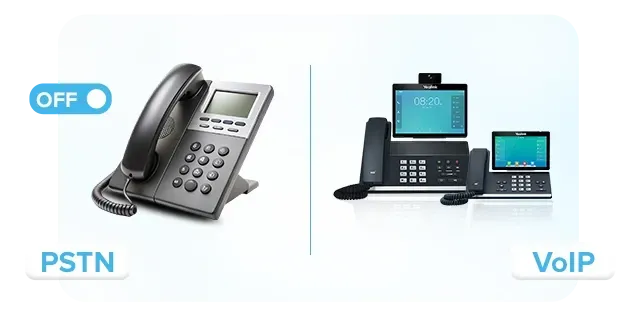
VoIP vs Traditional Landlines
The distinction between old and new technology is clear. Old-style analogue phone lines have many limitations. They are restricted to a set location to operate; they only offer basic calling features, require a large financial investment to grow, are limited by poorly maintained connections for analogue telephone services, and do not offer much to connect with other business tools.
In contrast, Voice over Internet Protocol or
VoIP solutions
have several advantages. You can use VoIP anywhere through the Internet and have advanced collaboration tools; you can quickly and cost-effectively add more phone lines; VoIP runs on modern technology that is supported; and VoIP integrates with other
business
tools such as Customer Relationship Management (CRM) software, e-mail and many others.
Preparing for the Big Switch Off: Your Migration Preparation Checklist
1. Complete Evaluation of Your Existing Infrastructure
2. Selecting the Right Provider
3. Planning Your Infrastructure
4. Migrating Critical Services
1. Complete Evaluation of Your Existing Infrastructure

To start, you'll want to complete a detailed evaluation of your current phone system. As part of that evaluation, you need to identify devices that are connected to your current landline phone line. This includes not just the most common devices like desk phones, but also less common devices such as alarm systems and payment terminals.
List every service dependent on PSTN or ISDN, document alarm systems, card machines, and telecare equipment, and note any special requirements or compliance needs specific to your industry.
This audit phase proves critical, as many businesses discover unexpected dependencies during this process. A manufacturing client recently found their water leak detection system connected to the phone line, something they hadn't considered until conducting a systematic review.
2. Selecting the Right Provider
Choosing appropriate VoIP providers UK is critical for successful migration. Consider reliability and service level agreements that guarantee uptime, UK-based support and expertise that understands local requirements, scalability for business growth without requiring system replacement, integration capabilities with existing systems and software, and transparent pricing without hidden costs.
At The VoIP Shop, we specialise in future-proof telecom solutions tailored to UK businesses. Our team understands the unique challenges British organisations face during this transition and provides personalised guidance throughout the process.
3. Planning Your Infrastructure
Ensure your business has sufficient broadband connection bandwidth to support voice traffic alongside existing data usage. Each concurrent call requires approximately 100kbps, so calculate your maximum simultaneous call volume and ensure adequate capacity. Network infrastructure must prioritise voice traffic through Quality of Service configuration, preventing call quality degradation during peak usage periods.
Backup power solutions address one significant concern about VoIP. Unlike traditional landlines that received power from the exchange, digital systems depend on local electricity. Uninterruptible Power Supply units ensure continued operation during outages, maintaining critical communication capabilities.
4. Migrating Critical Services
Address all PSTN-dependent systems systematically. Upgrade or replace alarm systems with IP-enabled alternatives, transition card machines to modern solutions that use internet connectivity, update door entry systems and lift phones to ensure compliance with safety regulations and verify telecare device compatibility for vulnerable users. Each category requires careful attention to ensure no functionality is lost during the transition.
The VoIP Shop's 6-Step Process: How to Migrate from PSTN/ISDN Phone Lines to VOIP/CLOUD Phone Systems
At The VoIP Shop, we've developed a proven methodology to ensure seamless transitions from PSTN/ISDN to Digital Voice. Our structured approach eliminates guesswork and ensures successful outcomes.
Step 1: Discovery & Consultation involves assessing your current infrastructure, understanding your business requirements, and identifying all affected systems. We conduct thorough site surveys to ensure nothing is overlooked.
Step 2: Solution Design sees our experts designing a tailored VoIP solution matching your operational needs and budget. We consider not just your current requirements but anticipated growth and changing needs.
Step 3: Infrastructure Preparation ensures your network and internet connectivity meet requirements for optimal voice quality. This may involve broadband upgrades or network configuration changes.
Step 4: Installation & Configuration includes professional installation of your new cloud phone system, including all devices and integrations with existing business applications.
Step 5: Testing & Training provides comprehensive testing of all features, plus staff training to maximise your investment and ensure everyone feels confident using the new system.
Step 6: Go-Live & Support ensures a smooth transition to your new system with ongoing technical support and monitoring. We don't disappear after installation; our team remains available to address any concerns.
Looking to Migrate your Analogue (Copper) Lines to VoIP?
Common Concerns About the PSTN Switch Off
Will VoIP Work During Power Cuts?
Unlike traditional landlines, which receive power from the exchange, VoIP depends on local electricity. However, businesses can mitigate this with uninterruptible power supply units, battery backup systems, hybrid solutions maintaining limited functionality, and mobile phone calls failover options. Many modern VoIP systems include automatic failover to mobile devices, ensuring continued communication even during extended outages.
Can I Keep My Existing Business Number?
Yes. Number portability ensures you retain your existing telephone numbers when migrating to VoIP. This maintains continuity for customers and preserves your business identity. The porting process typically takes 10-15 working days and is handled entirely by your provider. Your customers won't notice any difference; your number simply works on the new platform.
Is VoIP Reliable Enough for Business?
Modern VoIP for business offers reliability exceeding traditional PSTN when properly implemented. Quality of service configuration, adequate bandwidth, and professional installation ensure consistent performance. Many businesses actually experience improved call quality compared to their old analogue systems, particularly on long-distance calls.
Financial Considerations and ROI
Migration Costs and Long-Term Savings
PSTN to VoIP transition expenses include new phone equipment, installation and configuration, staff training, and potential network upgrades. However, these represent one-time investments that deliver ongoing returns. Newer tech, like VoIP, is actually much cheaper to run than PSTN lines. Businesses typically save 30-50% on ongoing telecommunications costs through lower per-minute charges, reduced maintenance, elimination of separate voice and data networks, and decreased equipment costs.
Early migration prevents inflated costs as demand peaks approach the
deadline. Businesses delaying until 2026 will face limited provider availability, higher installation charges, extended wait times, and rushed implementations, increasing error risk. Acting now ensures you secure competitive pricing and adequate time for proper planning and testing.

Technical Requirements for Successful VoIP Implementation
Bandwidth and Network Configuration
Adequate internet speed is crucial. Each concurrent voice call requires approximately 100kbps bandwidth. Calculate your needs based on maximum simultaneous calls10 concurrent calls require 1Mbps minimum, 25 calls need 2.5Mbps, and 50 calls require 5Mbps. Add buffer capacity for other internet usage to prevent quality degradation during peak periods.
Optimal
VoIP
performance requires Quality of Service prioritisation, ensuring
voice
packets receive priority, VLAN segmentation for
voice
traffic, separating it from data, sufficient router capacity to handle packet processing, and proper firewall configuration allowing
VoIP
traffic without creating security vulnerabilities.
Compatible Devices
Digital phone
equipment includes IP
desk phones
ranging from basic models to executive handsets, softphones, which are computer applications providing full functionality,
mobile
apps enabling staff to use business numbers on personal devices, conference
phones
for meeting rooms, and wireless headsets for staff who need mobility.
The VoIP Shop
provides comprehensive hardware solutions compatible with your chosen system, ensuring you have the right tools for your specific requirements.
Additional Services Affected: Broadband and Connected Systems
Adequate internet speed is crucial. Each concurrent voice call requires approximately 100kbps bandwidth. Calculate your needs based on maximum simultaneous calls10 concurrent calls require 1Mbps minimum, 25 calls need 2.5Mbps, and 50 calls require 5Mbps. Add buffer capacity for other internet usage to prevent quality degradation during peak periods.
Optimal
VoIP performance requires Quality of Service prioritisation, ensuring
voice packets receive priority, VLAN segmentation for
voice traffic, separating it from data, sufficient router capacity to handle packet processing, and proper firewall configuration allowing
VoIP traffic without creating security vulnerabilities.
Why Choose The VoIP Shop for Your Migration
As a specialist UK VoIP provider, we understand local market requirements, Openreach processes, regional connectivity variations, and British business needs. Our services include free quotes, site surveys, project management, installation, training, and ongoing technical support. We've successfully migrated hundreds of UK businesses from PSTN and ISDN to modern VoIP phone systems, ensuring zero disruption to operations.
We offer transparent pricing, no hidden costs, flexible contracts, scalable solutions, and quality equipment. Our team remains with you throughout the journey, from initial assessment through go-live and beyond.
Take Action Now: Don't Wait Until It's Too Late
With the PSTN switch-off approaching, proactive businesses are already reaping the benefits of digital communications. Don't risk becoming part of the last-minute rush.
Download Your Free Guide: The Ultimate Guide to the BT Landline Switch Off January 2027 provides a detailed timeline and milestones, technical specifications, vendor selection criteria, implementation checklists, and cost analysis frameworks.
Get Your Free Quote:
Request your Quote
to migrate from analogue to a Digital VoIP Phone System. Our experts will assess your requirements and provide a no-obligation migration proposal tailored to
your
business.
Frequently Asked Questions About The Big Switch Off
When is the next big switch off happening?
The final PSTN and ISDN switch-off will occur by January 31, 2027, extended from the original December 2025 deadline. However, businesses are advised to complete the migration by December 2025 to avoid last-minute complications.
What is the big switch off and why is it happening?
The big switch off is the shutdown of the UK's analogue telephone network (PSTN and ISDN). It's happening because the PSTN network can no longer sustain modern requirements and is becoming increasingly fragile and prone to failure, with maintenance costs spiralling.
Are landlines being phased out in the UK?
Yes. Traditional copper-based landlines are being replaced entirely by digital phone lines using VoIP technology. This landline change to digital affects all UK homes and businesses without exception.
What happens if I do nothing before the deadline?
If you take no action, your phone service will cease on January 31, 2027. You'll be unable to make or receive calls, and all devices connected to your landline, including alarms, card machines, and door entry systems, will stop functioning immediately.
Will my landline work without internet after the big switch off?
No. After the PSTN switch off, all phone services require an internet connection. Digital Voice and VoIP systems transmit calls over broadband rather than traditional copper wires, making internet connectivity essential.
Do I need a landline if I have a mobile phone?
For business purposes, professional phone systems remain essential. Whilst mobile phones suffice for some operations, most businesses require dedicated telephone solutions offering features like call routing, conferencing, voicemail-to-email, and integration with business applications.
How much does it cost to switch from landline to VoIP?
Costs vary based on your requirements. Basic small business setups start from £10-15 per user monthly for hosted solutions. Initial setup costs depend on complexity, but long-term savings typically offset upfront investment within 12-18 months through reduced call charges and maintenance costs.
Is VoIP better than PSTN for business use?
Yes. VoIP offers superior flexibility, features, reliability, and cost-efficiency compared to PSTN. Modern VoIP phone systems provide capabilities impossible with analogue technology, including remote access, advanced call management, video conferencing, and business application integration.
What is digital voice, and is it mandatory?
Digital Voice is the term for phone services delivered over internet connections rather than copper wires. Yes, migration is mandatory for all UK phone lines to transition to digital by January 2027. There are no exceptions to this requirement.
Can I keep my existing phone number when switching to VoIP?
Absolutely. Number portability ensures you retain all existing business numbers when migrating to VoIP. This process is standard and maintains continuity for your customers. Your number simply transfers to the new platform without changing.
The VoIP Shop is your trusted partner for navigating the big switch off. With deep expertise in UK telecommunications, we deliver reliable, cost-effective VoIP solutions tailored to businesses of all sizes. Contact us today to ensure your organisation is ready for the digital future.