Urgent B2B Update
The PSTN Switch Off 2027: What UK Businesses Must Do Before 31 January 2027
The UK PSTN switch off takes place on 31 January 2027. On this date, BT and Openreach will permanently retire the analogue Public Switched Telephone Network, and any phone line, alarm, card machine or other device still relying on it will stop working. The deadline was originally December 2025 and was moved to give vulnerable users more time to migrate.

last updated 07th September 2026
Key Takeaways
What is the PSTN switch off?
The PSTN switch off is the permanent shutdown of the UK's analogue copper telephone network by BT and Openreach on 31 January 2027. Every service that runs over an analogue phone line must move to a digital alternative, such as VoIP, before that date.
The PSTN switch off is also known as the landline switch off, the BT switch off, or simply "the Big Switch Off".
The PSTN (Public Switched Telephone Network) is the copper wire network that has carried UK phone calls for over a century. It's the same network your grandparents' phone used — and in many offices, it's still quietly running the fax machine, the fire alarm and the card terminal.
Openreach is retiring it for a simple reason: the copper network is old, increasingly expensive to maintain, and can't support the way businesses communicate today. Spare parts are scarce, the engineers who know the equipment are retiring, and every year the network stays open costs more to keep reliable.
This is one of the largest infrastructure changes in UK telecoms history. Roughly 14 million lines and channels are being migrated, and every UK business with any analogue service is affected, whether they know it yet or not.
PSTN switch off dates and timeline
Why was the switch off delayed to 2027?
The PSTN switch off was delayed from December 2025 to 31 January 2027. BT moved the deadline after concerns about telecare users and other vulnerable customers being migrated before safe digital alternatives were in place. The delay does not change what businesses need to do, only how long they have to do it.
If anything, the delay has created a false sense of security. Engineer availability and number-porting slots will tighten sharply in the final months before the deadline. Businesses that migrate in 2026 choose their timing; businesses that wait until late 2026 or early 2027 will take whatever slot they can get.
Who and what is affected?
If your business has anything plugged into a traditional phone socket, it's affected. The switch off reaches much further than desk phones and the non-obvious devices are the ones that catch businesses out.
Analogue phone lines
Every standard landline stops working on 31 January 2027. Calls simply won't connect. The replacement is a VoIP phone system delivered over your broadband.
ISDN2 and ISDN30
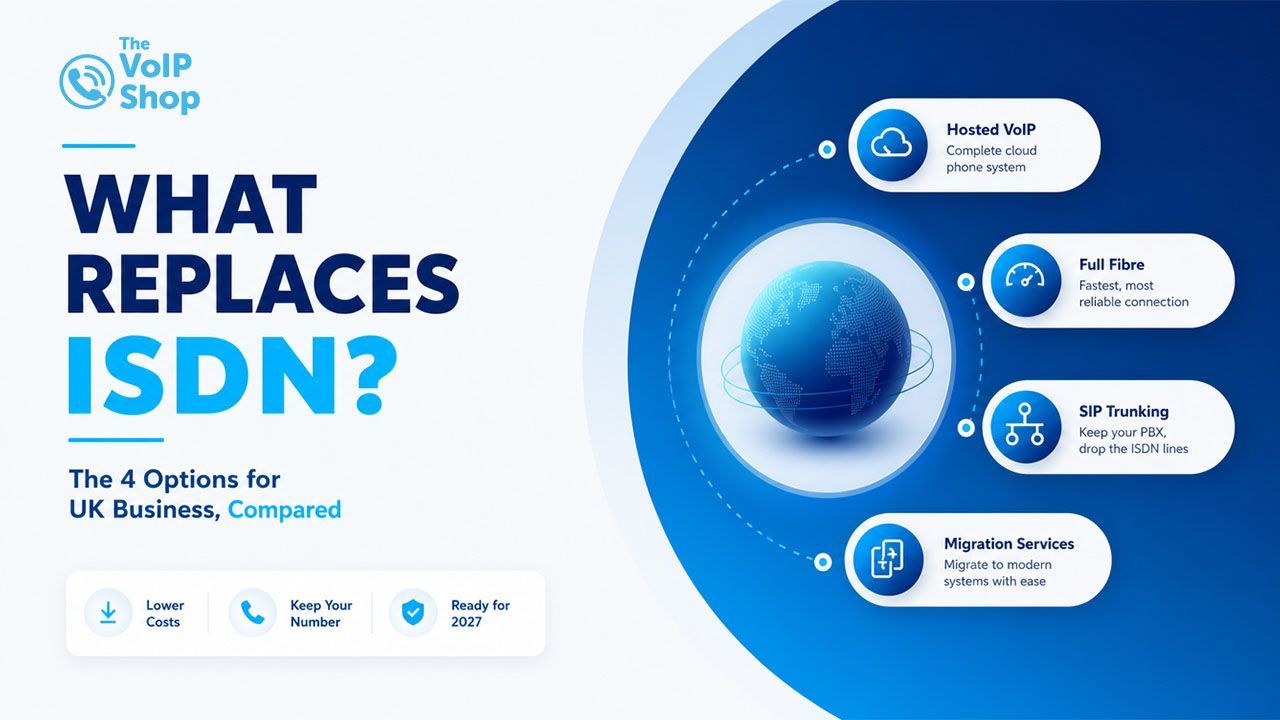
These digital lines run over the same infrastructure and are being withdrawn in the same programme. If your office PBX connects via ISDN, it needs to move to SIP trunking or a hosted cloud phone system.
Fire and intruder alarms
Many alarm panels dial out to monitoring centres over an analogue line. After the switch off, that signal path is gone. Panels need upgrading to IP, 4G/5G roaming SIM, or dual-path signalling, and your alarm maintainer must certify the change.
Telecare and health devices
Personal alarms and telecare units used in care settings rely on analogue dialling. These are exactly the devices the 2027 delay was designed to protect; every unit needs a tested digital replacement.
Lift emergency lines
UK regulations require a working emergency line in every passenger lift. Analogue lift lines stop working at switch off, which is a compliance issue, not just an inconvenience. GSM/4G lift units are the standard replacement.
EPOS and card payment terminals
Older card machines that dial out over a phone line will fail, meaning you can't take payments. Modern terminals connect over broadband or mobile data.
Door entry and gate systems
Intercoms that ring a phone line need replacing with IP or GSM equivalents.
Fax and franking machines
Analogue fax dies with the network. Online fax services or scan-to-email cover the gap for the businesses that still need it.
The pattern is the same for every device: audit it, identify the digital replacement, migrate it, test it, before the deadline, not after.
What replaces PSTN?
Voice services are moving to VoIP (Voice over Internet Protocol), delivered over broadband via hosted cloud phone systems or SIP trunking. Connectivity is moving to all-digital products such as SoGEA and full fibre (FTTP), which do not rely on the analogue network.
| Features | Hosted VoIP | SIP Trunking | SoGEA / FTTP |
|---|---|---|---|
| Best for | Most SMEs — complete cloud phone system, nothing to maintain on site | Businesses with a modern on-site PBX they want to keep | Replacing ADSL/FTTC broadband that depended on the phone line |
| Typical cost | £8–£20 per user/month | £4–£8 per channel/month | From ~£25–£45/month depending on speed |
| Timescale | 2–4 weeks | 2–6 weeks | 2 weeks (SoGEA) to 2–3 months (new FTTP) |
For most small and medium businesses, hosted VoIP is the natural path: your numbers, call routing, voicemail and mobile apps all live in the cloud, updates and maintenance are included, and adding a user takes minutes rather than an engineer visit.
How to prepare: the 6-step migration checklist
- Audit every line and connected device.
- Walk the building. List every phone socket and everything plugged into one — phones, alarms, lifts, card machines, door entry, fax. This list is your migration plan.
- Check your broadband is digital-ready.
- If you're on ADSL or standard FTTC, your broadband depends on the PSTN too. Move to SoGEA or full fibre (FTTP) first VoIP is only as good as the connection under it.
- Choose your VoIP solution and provider.
- Match the system to how your team actually works: desk phones, mobile apps, call recording, CRM integration. Look for UK-based support and proven migrations in your sector.
- Plan your number porting.
- Your numbers can move with you, but port them before the old line is ceased. A number attached to a ceased line can be difficult or impossible to recover.
- Migrate special services.
- Alarms, telecare, lift lines and payment terminals each need their own digital replacement, coordinated with the relevant maintainer. Do these in parallel with the phone system, not as an afterthought.
- Test, train, then cease the old lines.
- Run the new system alongside the old where possible, confirm every device works, train the team, then cancel the analogue lines in that order.
Watch: the PSTN migration explained
The migration checklist in video form, covering what to audit, which connected devices are commonly missed, and how a cloud phone system replaces the copper lines.
Is Your Business Ready for the UK Big Switch Off, from The VoIP Shop on YouTube
Starting at least six months before the deadline is recommended. A straightforward migration is quick; fibre installs and number porting are the things that add weeks.
How to prepare: how much does switching from PSTN to VoIP cost?
Most UK businesses pay roughly £8–£20 per user per month for a hosted VoIP system to replace PSTN lines, typically including calls, maintenance and updates. Many find this cheaper than continuing to rent analogue lines and maintain an ageing on-site phone system.
What moves the number within that range: handsets (softphone apps are cheapest; premium desk phones add a one-off or monthly cost), call bundles versus pay-as-you-go, and add-ons like call recording or CRM integration. At The VoIP Shop, business plans start from £13.95 per user per month with UK call bundles, 24/7 UK-based support and a dedicated account manager included.
The honest comparison isn't just line rental versus subscription. it's the total you spend today on line rental, call charges, PBX maintenance contracts and engineer call-outs, versus one predictable monthly figure. That's the calculation our free audit puts in front of you before you commit to anything
PSTN switch off FAQs
Frequently Asked Question about PSTN Switch off in UK
When is the PSTN switch off?
The UK PSTN switch off takes place on 31 January 2027. On this date BT/Openreach will retire the analogue Public Switched Telephone Network, and any phone line or service still relying on it will stop working. The deadline was moved from the original date of December 2025.
What is the PSTN switch off?
The PSTN switch off is the permanent retirement of the UK's analogue copper telephone network by BT/Openreach. All voice services are moving to digital, internet-based alternatives such as VoIP. The ageing copper network is increasingly costly to maintain and cannot support modern communication requirements.
Why was the PSTN switch off delayed to 2027?
BT moved the deadline from December 2025 to 31 January 2027 to allow more time to protect vulnerable customers and users of critical devices such as telecare alarms, after concerns were raised about early non-voluntary migrations. Businesses should not treat the delay as a reason to postpone planning.
Does the PSTN switch off affect broadband?
Yes. Broadband products delivered over the analogue phone network, such as ADSL and standard FTTC, are affected because they depend on PSTN infrastructure. Businesses on these products need to move to a standalone digital connection such as SoGEA or full fibre (FTTP).
What is replacing PSTN?
Voice services are moving to VoIP (Voice over Internet Protocol), delivered over broadband via hosted cloud phone systems or SIP trunking. Connectivity is moving to all-digital products such as SoGEA and full fibre (FTTP), which do not rely on the analogue network.
Is the ISDN switch off happening at the same time?
Yes. ISDN2 and ISDN30 digital lines run over the same infrastructure and are being withdrawn as part of the same programme. New ISDN orders were already stopped in September 2023 under the WLR stop sell, and remaining ISDN services will cease with the switch off.
What happens if I do nothing before the switch off?
Any service still running on an analogue line on 31 January 2027 will simply stop working. For a business this can mean losing inbound calls, card payments, alarm monitoring and lift emergency lines overnight. Migrating early avoids forced last-minute changes and engineer shortages near the deadline.
Are alarms, lifts and card machines affected by the PSTN switch off?
Yes. Fire and intruder alarms, telecare devices, lift emergency phones, door entry systems, EPOS and card payment terminals, and fax machines that dial over an analogue line are all affected. Each device needs to be audited and migrated to a digital-compatible alternative before the deadline.
Can I keep my phone number when I move to VoIP?
Yes. Your existing numbers can be ported to a VoIP provider, so customers can keep calling the same number. Porting should be planned before ceasing the old line, because a number attached to a ceased line can be difficult or impossible to recover.
How much does it cost to switch from PSTN to VoIP?
Most UK businesses pay roughly £8–£20 per user per month for hosted VoIP, typically including calls, maintenance and system updates. Many find this cheaper than maintaining analogue lines and an on-site PBX. Exact pricing depends on user count, handsets and call volumes; a free audit will confirm costs.
How long does it take to migrate from PSTN to VoIP?
A straightforward small-business migration can complete in a few weeks, while multi-site deployments with number porting, new connectivity and special services typically take one to three months. Lead times for full fibre installations and number porting are the most common causes of delay, so start early.
What should businesses do to prepare for the PSTN switch off?
Audit every phone line and connected device, check your broadband is digital-ready (SoGEA or FTTP), choose a VoIP solution, plan number porting, migrate special services such as alarms and lift lines, then test and cease the old lines. Starting at least six months before the deadline is recommended.
Written By | About the Author
Kully has over 15 years of experience in the VoIP and telecoms industry. Drawing on a background in telecoms sales and leadership, he provides expert, impartial advice on VoIP and cloud telephony solutions. As a lead author for The VoIP Shop, Kully helps businesses understand and adopt modern communication technologies