
⚠ Deadline: 31 January 2027 — Act now
What UK Businesses Should Do to Prepare for the PSTN Switch-Off
The UK's old copper phone network is being switched off permanently on 31 January 2027. If your business still relies on PSTN or ISDN lines, you need a clear plan — not next quarter, but now.
last updated 07th September 2026
⚠ UK Landline Network Retiring
A Step-by-Step Preparation Guide for UK SMEs
This guide gives you exactly what you need: a straightforward, step-by-step preparation checklist built
for UK businesses of all sizes.
You are already being financially penalised for staying on PSTN. Over 2,600 major PSTN incidents were recorded in 2024/25 — a 45% year-on-year increase as ageing copper infrastructure crumbles. Every month you delay, you are paying a premium to stay on a network that is failing.
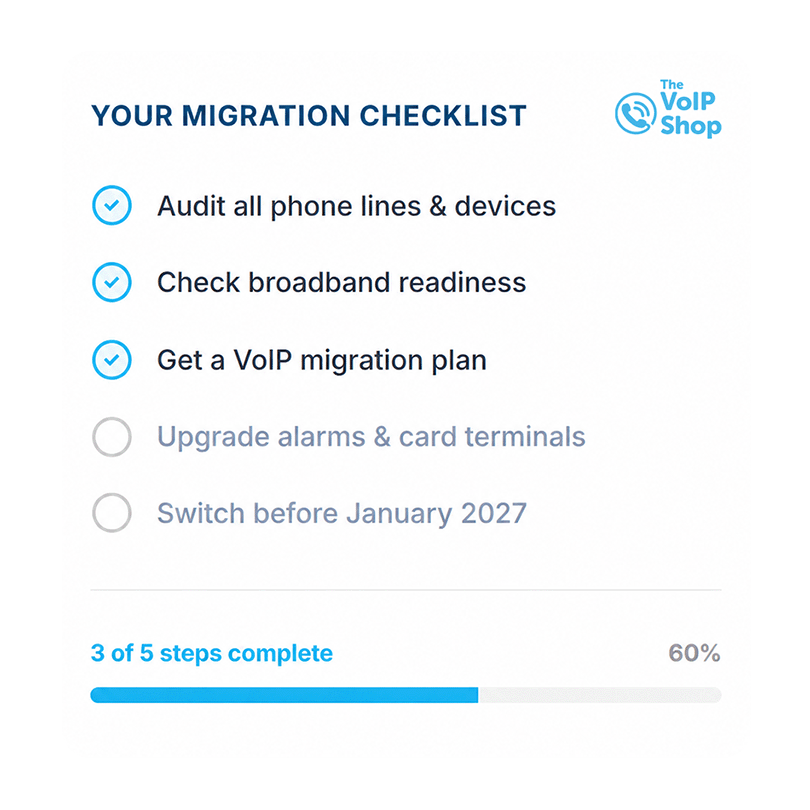
Your 6-Step PSTN Preparation Plan
You do not need to become a telecoms expert. Follow this structured process and you will be
ready well ahead of the deadline.
1
Audit Everything Connected to Your Phone Lines
Before anything else, you need to know what you have. Most businesses are surprised by how many systems quietly rely on a phone line beyond the obvious desk phones. Walk through your premises and check for:
Your communications provider will not automatically know what devices you have. That responsibility sits with you — and it needs to happen before you migrate, not during.
2
Check Your Broadband Is Ready
VoIP calls travel over your internet connection, so your broadband needs to be stable and fast enough to handle voice traffic alongside normal business usage. Ask your provider:
Questions to ask your provider
If you are still on FTTC or ADSL, now is the right time to upgrade to full-fibre broadband. This delivers faster speeds, lower latency, and a far more reliable foundation for your new phone system — benefiting your entire business, not just your calls.
3
Get a Migration Plan From a VoIP Specialist
Do not wait to be contacted by your current provider. The businesses that move earliest have the most options — on timing, on pricing, and on the solution that best fits how they work. When speaking to a specialist, ask directly:
Questions to ask a specialist
Companies like The VoIP Shop offer free business migration assessments that map your existing setup and recommend the cleanest path to digital — handling number porting, device compatibility, and ongoing support.
⚠ Availability is tightening. Engineer slots and number porting availability will reduce significantly as January 2027 approaches. Businesses booking migrations now are choosing from a full menu. By autumn 2026, that menu will be considerably shorter.
4
Upgrade Your Non-Phone Devices in Parallel
Phone lines are straightforward to migrate. The devices that use them quietly in the background are where delays happen — and where businesses get caught closest to the deadline.
s
🔥 Fire & intruder alarms
Your monitoring company needs to upgrade the communicator unit. Some older systems need full replacement. Procurement and installation take time. Start now.
🛗 Lift phones
Your lift maintenance contractor handles this, but they are facing a surge in demand nationally. Book early to secure a slot.
💳 Card payment terminals
Most modern PDQ machines already support 4G or IP connectivity. Contact your payment processor to switch the connection method — it may be a five-minute call.
📷 CCTV & door entry systems
Your installer can advise on IP-based alternatives. In many cases this is a configuration change rather than a full hardware replacement.
Getting these upgraded before your phone line migration means a clean, planned switchover — not a scramble.
5
Choose the Right Solution for Your Business
There is no single answer that fits every business. The right solution depends on your setup, your team size, and how you work.s
Hosted VoIP / Cloud PBX
Right for most SMEs. Your phone system lives in the cloud. Calls travel over your broadband. You keep your existing numbers. Setup is fast, costs are lower, and the system scales with you — no engineer visits to add or remove lines.
Should accompany your VoIP migration wherever possible. Provides the bandwidth and reliability to support VoIP calls — and delivers faster internet for your entire business.
Suits businesses with an existing PBX investment to preserve. You replace the PSTN connection with a digital IP alternative while keeping your current hardware.
Whichever route you take, make sure your provider offers genuine business continuity planning — including what happens to your calls during a broadband outage or power cut, since digital lines require power at your premises to function.
6
Switch Early — Before the Deadline, Not Because of It
The businesses that switched early did so on their own terms — with time to test, time to train staff, and time to resolve any issues without pressure. Residential PSTN customers dropped from 5.2 million to 3.2 million in a single year between 2024 and 2025. Those that moved early chose their timing. Those that left it late did not.
Businesses that wait until the final weeks of January 2027 will be competing for engineer time, scrambling to port numbers, and hoping nothing goes wrong. Some will experience outages. Some will have payment terminals that stop working. Some will discover their fire alarm monitoring went silent without anyone noticing. All of that is entirely avoidable — if you act now.
Watch: how to prepare for the switch off
What to check before you start, which devices are easy to miss, and how the migration from analogue and ISDN lines to a cloud phone system actually runs.
Is Your Business Ready for the UK Big Switch Off, from The VoIP Shop on YouTube
Why the Cost of Waiting Is Already Rising
Here is something most businesses do not realise: you are already being financially penalised for staying on PSTN. Openreach has introduced a deliberate schedule of price increases throughout 2026.
1 April 2026
+20%
Legacy WLR line rental rises by 20%
1 July 2026
+40%
A further 40% increase on legacy lines
1 October 2026
+40%
A final 40% hike before switch-off
By October 2026, you will be paying roughly double what you paid in 2025 — for a service that is three months away from being switched off permanently. Switching now does not just protect you from disruption. It saves you money immediately.
Not Sure Which Solution Fits Your Business?
The VoIP Shop offers free, no-obligation consultations for UK businesses assessing their options ahead of the switch-off. Get expert advice with no pressure and no upselling.
Looking for a complete
VoIP phone system for your business? Explore plans and features →
What You Gain the Moment You Switch
Preparing for the switch-off is not just about avoiding problems. It is about unlocking a better way to work.
Lower Monthly Costs
VoIP calls cost significantly less per minute. Cloud-based systems eliminate expensive on-site
PBX hardware and maintenance contracts.
Work From Anywhere
Calls route to any device — desk phone, laptop, or mobile — on the same number with the same professional setup.
Scale on Demand
Add or remove lines instantly as a software change, not an engineer visit. No delays, no penalty charges.
Features as Standard
Call recording, auto-attendant, voicemail to email,
CRM integration — standard inclusions, not premium add-ons.
Faster, More Reliable Broadband
Upgrading to FTTP benefits everyone in your business — not just your phones. Faster speeds, lower latency, better reliability.
Ready to Prepare? Talk to The VoIP Shop Today
The VoIP Shop has helped hundreds of UK businesses migrate from PSTN and ISDN to modern, reliable VoIP systems — on time, on budget, and with zero disruption to day-to-day operations. Whether you have a handful of lines or a complex multi-site setup, the team will build a migration plan around you.
Don't wait for January. Get ahead of it.
Frequently Asked Questions
Everything you need to know about preparing for the PSTN switch-off.
Deadline: 31 January 2027. Sources: GOV.UK, Openreach, House of Commons Library, Ofcom. Data accurate as of April 2026.