
⚠️ Urgent: UK Landline Network Retiring
What UK Businesses Should Do After the PSTN Switch-off
The UK's old landline network is being retired. Phones, card machines, alarms, and lift lines will stop working if left on PSTN. Act early to avoid disruption and turn the switch-off into a planned upgrade.
last updated 07th September 2026
What is the PSTN switch-off – and why should you care?
For decades, UK businesses have relied on the Public Switched Telephone Network (PSTN) – the copper-based system behind traditional landlines and ISDN services. It was built for voice calls in a very different era.
The Old Network is Retiring
Telecoms providers are retiring the old analogue network. It is costly to maintain, hard to support, and cannot keep up with how modern
businesses work.
Services Will Stop Working
When switched off, any service depending on a copper phone line will stop working. This includes landlines, ISDN, and "hidden" devices like alarms and card terminals.
You Have Time to Plan
The good news is that you have time to plan – but only if you start now. Moving to digital, IP-based services over broadband and fibre is the solution.
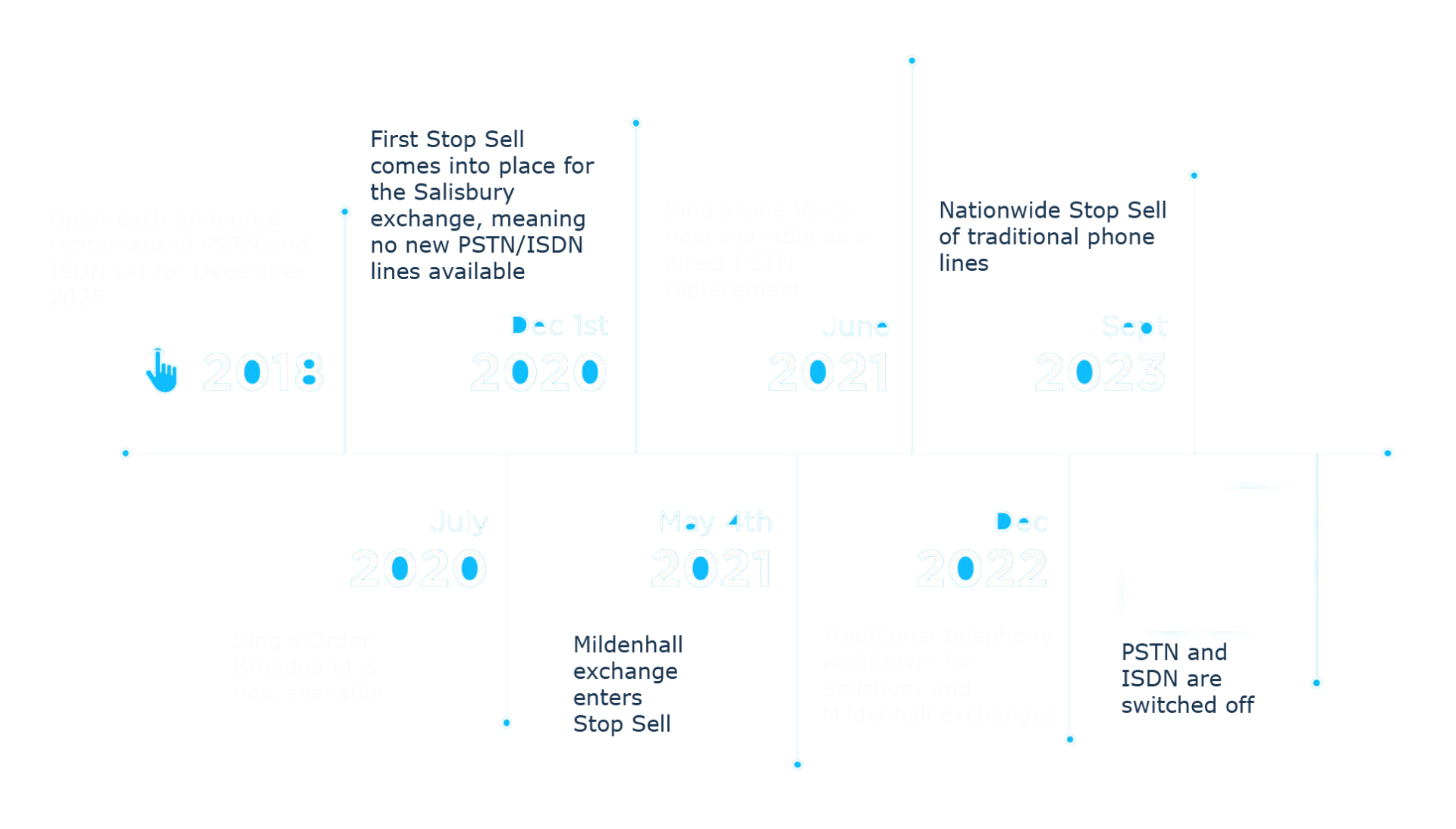
The Road to the 2025 Switch-Off
The retirement of the PSTN network has been in progress since 2018. With the nationwide stop-sell already in effect,
the final switch-off is fast approaching.
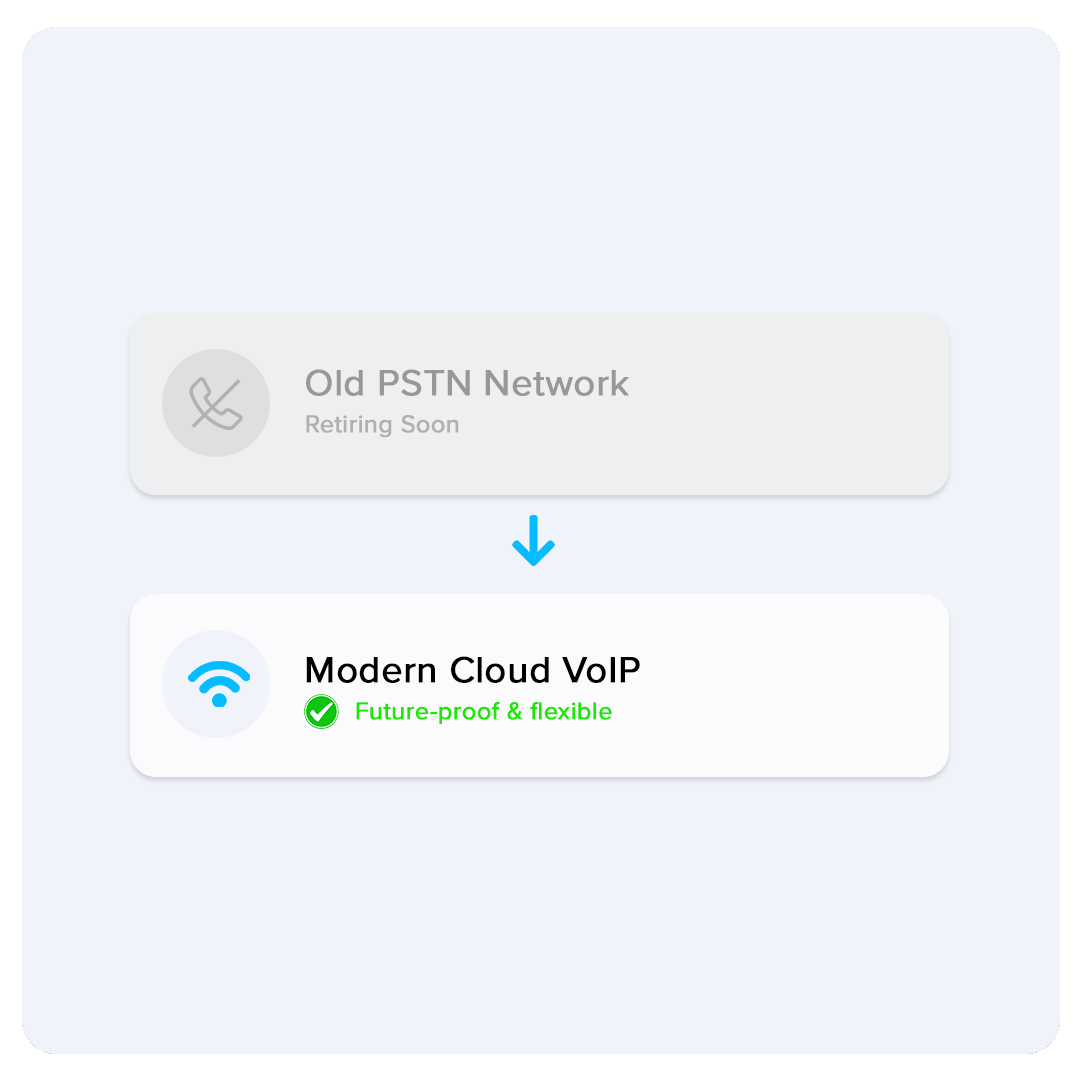
What actually changes when PSTN goes away?
Instead of a "phone line" and a separate "internet line", you will have one digital connection carrying everything:
voice, video, data, and cloud services.
Systems in your business that may be affected
Many SMEs think "we just have a couple of landlines" and then discover far more is hiding behind the scenes.
Use this as a starting checklist.
Main office phones
Desk phones or a small phone system on landlines and ISDN.
Next step:
Plan a move to a hosted VoIP or cloud phone solution.
Branch/home lines
Single analogue lines for small locations
Next step:
Consolidate into a cloud phone system using broadband.
Card machines (PDQs)
Authorisation over a dial-up phone line
Next step:
Check for IP, WiFi or mobile-connected terminals.
Security & fire alarms
Monitoring signals sent over copper phone lines.
Next step:
Ask for digital-ready equipment with power backup.
Lift emergency phones
Emergency call lines powered by PSTN.
Next step:
Talk to your lift provider about compliant digital alternatives.
Door entry/intercoms
Call-through or control over analogue lines.
Next step:
Include these in your survey and plan upgrades.
Fax machines & modems
Analogue fax/data over PSTN.
Next step:
Replace with secure e-fax or digital document workflows.
If you are unsure how some of these are wired, your facilities manager, IT support partner, or telecoms provider can help you trace what is connected where.
A simple, 5-step plan for UK SMEs
You do not need to become a telecoms expert to handle the PSTN switch-off. The key is to follow a
structured but straightforward process.
1
List every line and device
Pull a recent phone bill and note every line. Walk through your site and look for anything plugged into a phone socket.
s
2
Get a VoIP Specialist Review
Assess your current setup to identify what should be retained, improved, or replaced, and receive guidance for a smooth transition without unnecessary upselling or disruption.
3
Prioritise what is critical
Focus first on customer-facing numbers, payment systems, and emergency lines. Phase changes sensibly.
s
4
Check your broadband is ready
Ensure your connection is stable and fast enough to handle voice calls alongside normal internet usage.
s
5
Choose the right VoIP solution
Look for easy number porting, mobile apps, clear pricing, and UK-based support from specialists like The VoIP Shop UK.s
Watch: the migration in five minutes
The same five steps in video form, covering what to audit first, how numbers are kept, and what a cloud phone system replaces once the copper lines are gone.
Is Your Business Ready for the UK Big Switch Off, from The VoIP Shop on YouTube
Real-world scenarios: what this looks like in practice
BEFORE
AFTER SWITCH-OFF
BEFORE
AFTER SWITCH-OFF
BEFORE
AFTER SWITCH-OFF
Why acting early beats waiting
It can be tempting to park this under "deal with later". But leaving your PSTN migration until the last minute carries several risks, including capacity pressure, forced quick fixes, and potential downtime.
Compare providers and solutions calmly
Schedule work at quieter times of year
Allow sufficient time for structured staff training and adoption
Start benefiting from modern features sooner
Think of this as a planned upgrade, not an annoying problem.

How The VoIP Shop UK can help
You do not need to untangle this alone. We specialise in helping UK SMEs move smoothly from PSTN and ISDN to modern, all-IP communications. We'll audit your setup, recommend the right solution, and manage a phased migration so you stay reachable throughout.
Ready to future-proof your business?
Looking for a complete
VoIP phone system for your business? Explore plans and features →
You do not need to untangle this alone. We specialise in helping UK SMEs move smoothly from PSTN and ISDN to modern, all-IP communications. We'll audit your setup, recommend the right solution, and manage a phased migration so you stay reachable throughout.
Frequently Asked Questions
Everything you need to know about the PSTN switch-off.