Openreach Stop Sell Data and UK PSTN Migration Statistics
15+ years in UK Telecom | Last updated: Aug 2026

Executive Summary
This is a data report. If you are looking for a plain explanation of what the PSTN switch off means for your business and what to do about it, read our main guide to the PSTN switch off first. This page is the underlying numbers.
The UK's Public Switched Telephone Network is retired on 31 January 2027. On 31 July 2026, with exactly six months remaining, Openreach confirmed that around 1.5 million lines are still running on the old copper network, including approximately 350,000 business premises.
We took that figure and did the arithmetic. Allowing for weekends and bank holidays, there are 127 working days left. Migrating 350,000 business premises in that window requires 2,756 businesses to complete migration every single working day.
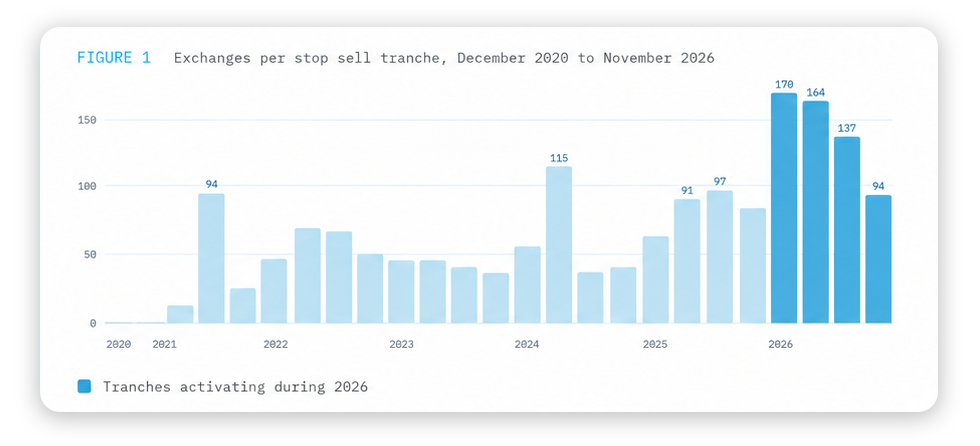
We then compiled the full Openreach stop sell programme from its first pilot in December 2020 through to Tranche 22 in November 2026. That series has never been published in one place. It shows something the individual announcements do not: 565 exchanges enter stop sell during 2026, one third of the entire six year programme, in its final year.
This report sets out the migration rate, the complete tranche history, the year by year concentration, and a regional breakdown. Every figure is either taken directly from a named, dated, publicly available source, or calculated by us from those sources with the method shown
Key Takeaways
Key Stop Sell and Migration Figures
31 January 2027
PSTN retirement date
Approx 350,000
Business premises still to migrate
2,756
Businesses per working day required
127
Working days remaining as of 31 July 2026
Approx 1.5 million
Lines still on the copper network
23.3%
Business share of remaining lines
565
Exchanges entering stop sell during 2026
33.4%
Share of the whole programme falling in 2026
1,747
Total exchanges in the stop sell programme
Sources: Openreach, July 2026. BT Wholesale, November 2025. Rate calculations by The VoIP Shop.
How Many UK Businesses Must Migrate Every Day?
2,756 UK business premises must complete PSTN migration every working day between now and 31 January 2027.
Openreach confirmed on 31 July 2026 that approximately 350,000 business premises remain on the network. Here is how that translates.
| Measure | Figure |
|---|---|
| Calendar days remaining | 184 |
| Weeks remaining | 26.3 |
| Working days remaining | 127 |
| Businesses per working day | 2,756 |
| Businesses per working hour, 8 hour day | 344 |
| Businesses per week | 13,315 |
Working days exclude weekends and four UK bank holidays falling in the window: 31 August 2026, 25 December 2026, 28 December 2026, and 1 January 2027.
The equivalent figure across all remaining lines, business and residential combined, is 11,811 per working day.
Openreach has warned that leaving migration to the final weeks makes it harder to secure the engineering support needed. That warning has more weight alongside the rate. Every business that waits is joining a queue of 350,000 competing for the same finite engineering capacity in the same 127 days.
"Inaction is no longer about uncertainty but preparedness, and those who wait risk leaving customers exposed to avoidable service disruption."
James Lilley, Director of All-IP, Openreach, 31 July 2026
The Full Openreach Stop Sell Tranche History
Openreach announces stop sell in tranches. Each announcement is made separately, and the individual numbers look unremarkable. Assembled into one series, the shape of the programme becomes clear.
Below is the complete history from the first Salisbury pilot in December 2020 to Tranche 22 in November 2026.
| Tranche | Exchanges | Stop sell date | Cumulative |
|---|---|---|---|
| Salisbury (pilot) | 1 | 1 Dec 2020 | 1 |
| Mildenhall (pilot) | 1 | 4 May 2021 | 2 |
| Tranche 1a | 13 | 29 Jun 2021 | 15 |
| Tranche 1b | 94 | 13 Oct 2021 | 109 |
| Tranche 2 | 26 | 13 Oct 2021 | 135 |
| Tranche 3 | 47 | 25 Jan 2022 | 182 |
| Tranche 4 | 69 | 29 Apr 2022 | 251 |
| Tranche 5 | 67 | 2 Aug 2022 | 318 |
| Tranche 6 | 51 | 1 Nov 2022 | 369 |
| Tranche 7 | 46 | 8 Feb 2023 | 415 |
| Tranche 8 | 46 | 9 May 2023 | 461 |
| Tranche 9 | 41 | 8 Aug 2023 | 502 |
| Tranche 10 | 37 | 9 Nov 2023 | 539 |
| Tranche 11 | 56 | 16 Feb 2024 | 595 |
| Tranche 12 | 115 | 4 Jun 2024 | 710 |
| Tranche 13 | 39 | 16 Aug 2024 | 749 |
| Tranche 14 | 41 | 8 Nov 2024 | 790 |
| Tranche 15 | 63 | 17 Feb 2025 | 853 |
| Tranche 16 | 91 | 26 May 2025 | 944 |
| Tranche 17 | 97 | 19 Aug 2025 | 1,041 |
| Tranche 18 | 84 | 6 Nov 2025 | 1,125 |
| Tranche 19 | 170 | 14 Feb 2026 | 1,295 |
| Tranche 20 | 164 | 5 Jun 2026 | 1,459 |
| Tranche 21 | 137 | 19 Aug 2026 | 1,596 |
| Tranche 22 | 94 | 6 Nov 2026 | 1,690 |
| Undated | 43 | To be confirmed | 1,733 |
A further 15 exchanges have been removed from stop sell. The BT Wholesale register lists 1,747 exchanges in total.
A note on reconciliation. The published tranche totals, plus the undated exchanges, plus those removed, come to 1,748 against a stated total of 1,747. That single exchange difference is present in the source document. We have reproduced the figures as published rather than adjusting them.
Which Year Carries the Most Stop Sell Exchanges?
2026 is the largest year of the programme by a wide margin.
| Year | Exchanges entering stop sell | Share of programme |
|---|---|---|
| 2020 | 1 | 0.1% |
| 2021 | 134 | 7.9% |
| 2022 | 234 | 13.8% |
| 2023 | 170 | 10.1% |
| 2024 | 251 | 14.9% |
| 2025 | 335 | 19.8% |
| 2026 | 565 | 33.4% |
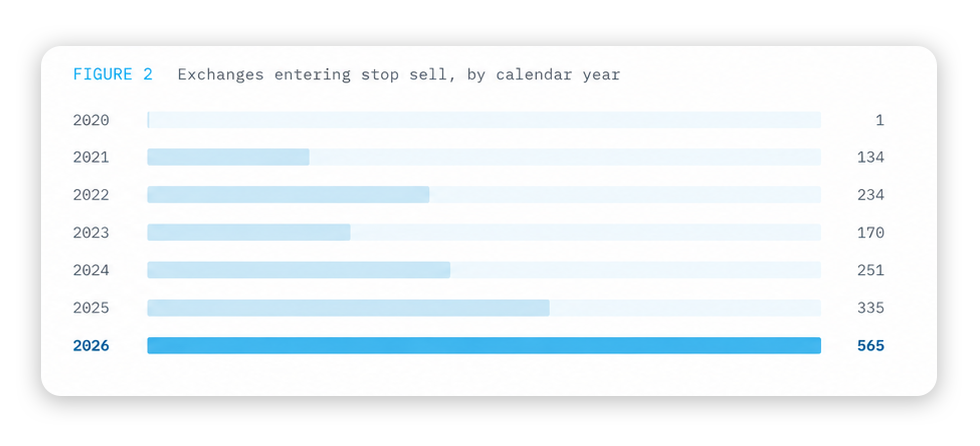
One third of a programme that began in December 2020 is being delivered in its final year.
Tranche 19, activating on 14 February 2026, covered 170 exchanges on its own. That is exactly the same number Openreach delivered across the whole of 2023, spread over four separate tranches. It remains the largest single tranche in the programme's history.
Tranche 20 followed in June 2026 with 164. Tranche 21 activates on 19 August 2026 with 137.
From the first pilot through to Tranche 18, tranche sizes ranged from 13 to 115 exchanges, with a median of 51. From Tranche 19 onward the range is 94 to 170. The programme roughly tripled in pace as the deadline approached.
Does Stop Sell End When the PSTN Is Switched Off?
No. Stop sell continues past 31 January 2027.
This is one of the most common misunderstandings about the programme, and it matters for planning.
Tranche 22 activates on 6 November 2026, inside the switch off window. But Openreach notified a further 112 exchanges on 27 July 2026, and providers receive twelve months notice before a stop sell activates. That places those exchanges in mid 2027, months after the analogue network is gone.
The reason is scope. Stop sell restricts the sale of copper based products in general, not only analogue voice. It covers copper broadband as well. The 31 January 2027 date ends the PSTN. Stop sell continues until copper itself is retired.
How Stop Sell Works
Stop sell is triggered when full fibre becomes available to more than 75 per cent of premises connected to a given exchange. Openreach gives communications providers twelve months notice before it activates.
Once active, customers on that exchange who want to switch, upgrade, or regrade cannot take a copper based product. Existing services are not disconnected.
Products withdrawn under the programme include WLR3 analogue, ISDN2, ISDN30, SMPF, and Narrowband Line Share and Classic products.
For what this means in practice for a business, and what to do about it, see our PSTN switch off guide.
Notified versus active: two different numbers
Coverage of the programme uses two figures that are often conflated.
Notified exchanges have received the twelve month stop sell notice but the restriction is not yet in force.
Active exchanges have a live stop sell. Openreach confirmed on 27 July 2026 that stop sell will be active in 1,572 exchanges by 20 August 2026, covering approximately 15.4 million premises, which is 57 per cent of its full fibre footprint.
Both figures are correct. They measure different stages, and they are not interchangeable.
How Many Remaining PSTN Lines Belong to Businesses?
Nearly one in four. 350,000 of the 1.5 million remaining lines, or 23.3 per cent
Businesses are over represented in the tail of the migration, and they carry more dependencies per line than households do.
A residential line usually carries a phone. A business line frequently carries a payment terminal, a lift alarm, a fire alarm panel, a door entry system, a franking machine, or a CCTV link.
Openreach specifically named payment terminals, lift alarms, and security systems among the services at risk. Once the network is withdrawn, these may stop working unless they have been upgraded or replaced with digital alternatives.
A household that misses the deadline loses a phone. A business that misses it can lose the ability to take payment.
What Is Happening to Line Rental Prices?
Openreach Wholesale Line Rental will cost double its early 2026 price by 1 October 2026.
| Date | Change | Applies to |
|---|---|---|
| Baseline | £10.65 | WLR basic rental |
| 1 April 2026 | +20% | WLR basic and other variants |
| 1 July 2026 | +40% | WLR basic and other variants |
| 1 October 2026 | +40% | WLR basic and other variants |
Alongside the increases, Openreach has introduced migration incentives including free or discounted connection to SOGEA where full fibre is not yet available, the Equinox pricing scheme, a try before you buy offer on new to network full fibre orders, an offer on existing Ethernet Access Direct lines at 1Gbps and below, and free connection for providers migrating legacy voice only lines.
The practical effect is that staying on an analogue line is now becoming more expensive than moving off it.
Where Has Full Fibre Rollout Reached?
| Measure | Figure |
|---|---|
| Premises reached by Openreach full fibre | 23.5 million |
| Share of UK | Approx. 66% |
| Build rate | Approx. 1 million premises every 3 months |
| Target (end of 2026) | 25 million premises |
| Target (early next decade) | Up to 30 million premises |
Source: Openreach, 27 July 2026
Regional Example: Leicestershire
To show how the national programme lands locally, we extracted every Leicestershire exchange from the BT Wholesale register.
26 Leicestershire exchanges are in the stop sell programme.
| Exchange | Location | Code | Stop sell date | Tranche |
|---|---|---|---|---|
| Stoneygate | Leicester | EMSTNYG | 4 Jun 2024 | 12 |
| Kirby Muxloe | Leicester | EMKRBYM | 17 Feb 2025 | 15 |
| Saint Barnabas | Leicester | EMSTBBS | 17 Feb 2025 | 15 |
| Hinckley | Hinckley | EMHINCK | 17 Feb 2025 | 15 |
| Rotherby | Frisby on the Wreake | EMROTTB | 17 Feb 2025 | 15 |
| Evington | Leicester | EMEVING | 26 May 2025 | 16 |
| Thurnby | Leicester | EMTHRNB | 26 May 2025 | 16 |
| Coalville | Coalville | EMCOALV | 26 May 2025 | 16 |
| Rearsby | Rearsby | EMRRSBB | 26 May 2025 | 16 |
| Waltham On The Wolds | Waltham on the Wolds | EMWLTHA | 26 May 2025 | 16 |
| Somerby | Somerby | EMSOMER | 19 Aug 2025 | 17 |
| Scalford | Harby | EMSCALF | 19 Aug 2025 | 17 |
| Knipton | Croxton Kerrial | EMKNIPT | 19 Aug 2025 | 17 |
| Market Harborough | Market Harborough | EMMRKTH | 6 Nov 2025 | 18 |
| Medbourne Green | Medbourne | EMMEDBO | 6 Nov 2025 | 18 |
| Ibstock | Ibstock | EMIBSTO | 6 Nov 2025 | 18 |
| Glenfield | Leicester | EMGLNFI | 14 Feb 2026 | 19 |
| Oadby | Leicester | EMODDBY | 14 Feb 2026 | 19 |
| Thurlaston | Thurlaston | EMTHURL | 14 Feb 2026 | 19 |
| Birstall | Birstall | EMBIRSS | 5 Jun 2026 | 20 |
| Wymondham | Wymondham (Melton) | EMWMNDH | 5 Jun 2026 | 20 |
| Ashby De La Zouch | Ashby-de-la-Zouch | EMASHBB | 19 Aug 2026 | 21 |
| Loughborough | Loughborough | EMLGHBO | 19 Aug 2026 | 21 |
| Hathern | Loughborough | EMHTHER | 19 Aug 2026 | 21 |
| Goscote | Syston | EMGSCTE | 19 Aug 2026 | 21 |
| Tilton | Tilton on the Hill | EMTILTO | 6 Nov 2026 | 22 |
Melton Mowbray was notified separately as part of Tranche 25 on 27 July 2026, and is not yet in the published register.
Three county towns worth calling out:
- Loughborough stop sell activates on 19 August 2026, alongside Hathern, Syston and Ashby de la Zouch
- Coalville has been under stop sell since 26 May 2025
- Hinckley has been under stop sell since 17 February 2025
Seven Leicester city exchanges are already under stop sell: Stoneygate, Kirby Muxloe, Saint Barnabas, Evington, Thurnby, Glenfield and Oadby.
For a wider view of which UK areas are affected and when, see our UK landline switch off cities map.
What This Means for UK Businesses
Three practical conclusions follow from the data.
Capacity is the constraint, not awareness. 2,756 businesses per working day, for 127 working days, is a demanding schedule for any supply chain. Openreach has said as much. The businesses that migrate early are competing for engineering resource against a much smaller field than those who leave it to December.
The programme accelerated, and most of it happened recently. Of the 1,459 exchanges activated by 31 July 2026, 669 have gone live since the start of 2025. That is 46 per cent of all activations in the most recent 19 months of a programme that began in December 2020. Any assessment of exposure made before 2025 is now out of date.
The risk is rarely the phone. Most businesses know their handsets need replacing. Far fewer have audited the lift alarm, the card terminal, the fire panel, the door entry system, or the CCTV link. Those are the services that fail quietly on 31 January 2027.
Openreach has confirmed it will begin issuing formal notifications to providers with outstanding migrations. Businesses that have not heard from their provider should not read that silence as safety.
Frequently Asked Questions
How many businesses need to migrate each day?
2,756 every working day between 31 July 2026 and the 31 January 2027 deadline, based on 127 working days after weekends and bank holidays.
How many UK businesses are still on the PSTN?
Approximately 350,000 business premises as of 31 July 2026, out of around 1.5 million lines in total. That is 23.3 per cent of all remaining lines.
How many exchanges are in the Openreach stop sell programme?
1,747 exchanges in total. Stop sell will be active in 1,572 of them by 20 August 2026, covering approximately 15.4 million premises.
Which year has the most stop sell activations?
2026, with 565 exchanges. That is 33.4 per cent of the entire programme in its final year.
When does stop sell activate in my exchange?
The full tranche table above gives every activation date from December 2020 to November 2026. Our Leicestershire table lists 26 county exchanges individually. For a map of affected areas, see our UK landline switch off cities map.
Does stop sell end when the PSTN is switched off?
No. Stop sell restricts copper broadband as well as analogue voice, so tranches continue past 31 January 2027.
Where does this data come from?
Openreach press releases dated 27 and 31 July 2026, and the BT Wholesale stop sell register published November 2025. All sources are linked in the methodology section, and every calculation shows its working.
What should my business actually do about this?
That is covered in our PSTN switch off guide, which explains the migration process step by step.
Methodology and Data Sources
This report combines primary source figures with our own calculations. Where a figure is calculated rather than published, the method is stated.
Published figures
BT Wholesale, "Product stop sells and FTTP exchange upgrades", November 2025.
Used for: tranche dates and exchange counts for all 22 tranches and both pilots, the full 1,747 exchange register, withdrawn product scope, and the Leicestershire extraction.
Openreach, 31 July 2026, "Openreach warns businesses: just six months left before the UK's old phone network is switched off".
Used for: 350,000 business premises, 1.5 million remaining lines, PSTN retirement date, WLR pricing schedule, migration incentives, services at risk, James Lilley quote.
Openreach, 27 July 2026, "Openreach puts a stop to copper for another half million premises in bid to push customers to new digital lines".
Used for: active stop sell totals, Tranche 25 notification, full fibre footprint and targets, stop sell trigger threshold, notice period.
Our calculations
Daily migration rate. 350,000 business premises divided by working days between 31 July 2026 and 31 January 2027. Working days exclude weekends and four England and Wales bank holidays falling in the window: 31 August 2026, 25 December 2026, 28 December 2026, and 1 January 2027. This gives 127 working days and a rate of 2,756 per working day.
Annual tranche totals. Exchange counts summed by the calendar year of each tranche's stop sell activation date, using the BT Wholesale figures. Shares are expressed against the 1,690 exchanges with confirmed dates.
Business share of remaining lines. 350,000 divided by 1,500,000.
Leicestershire extraction. Every exchange in the BT Wholesale register with a Leicestershire location, identified by the Exchange Location column.
Reconciliation. Published tranche totals plus undated plus removed exchanges come to 1,748 against a stated register total of 1,747. This one exchange difference exists in the source document and has not been adjusted.
Contains public sector information licensed under the Open Government Licence v3.0.
This page is updated each time Openreach announces a new stop sell tranche.
Citation and Usage Rights
This report may be cited, quoted, or referenced in full or in part, provided attribution is given to:
"Openreach Stop Sell Data and UK PSTN Migration Statistics [The VoIP Shop]"
Journalists and researchers are welcome to use the tranche table and the daily migration rate calculation with attribution.
Get Ready Before January 2027
The VoIP Shop is the UK's only 5 star rated VoIP provider with 24/7 UK based support and NHS Framework approval. We have moved businesses off the PSTN since 2014. New to this? Start with our PSTN switch off guide.
If you already know you are affected and want to know which of your lines and connected services need moving, we will tell you
Written By | About the Author
Kully Hothi
has over 15 years of experience in the VoIP and telecoms industry. Drawing on a background in telecoms sales and leadership, he provides expert, impartial advice on VoIP and cloud telephony solutions. As a lead author for The VoIP Shop,
Kully Hothi
helps businesses understand and adopt modern communication technologies