
Can I Have Voicemails Transcribed and
Sent Straight to My Email?
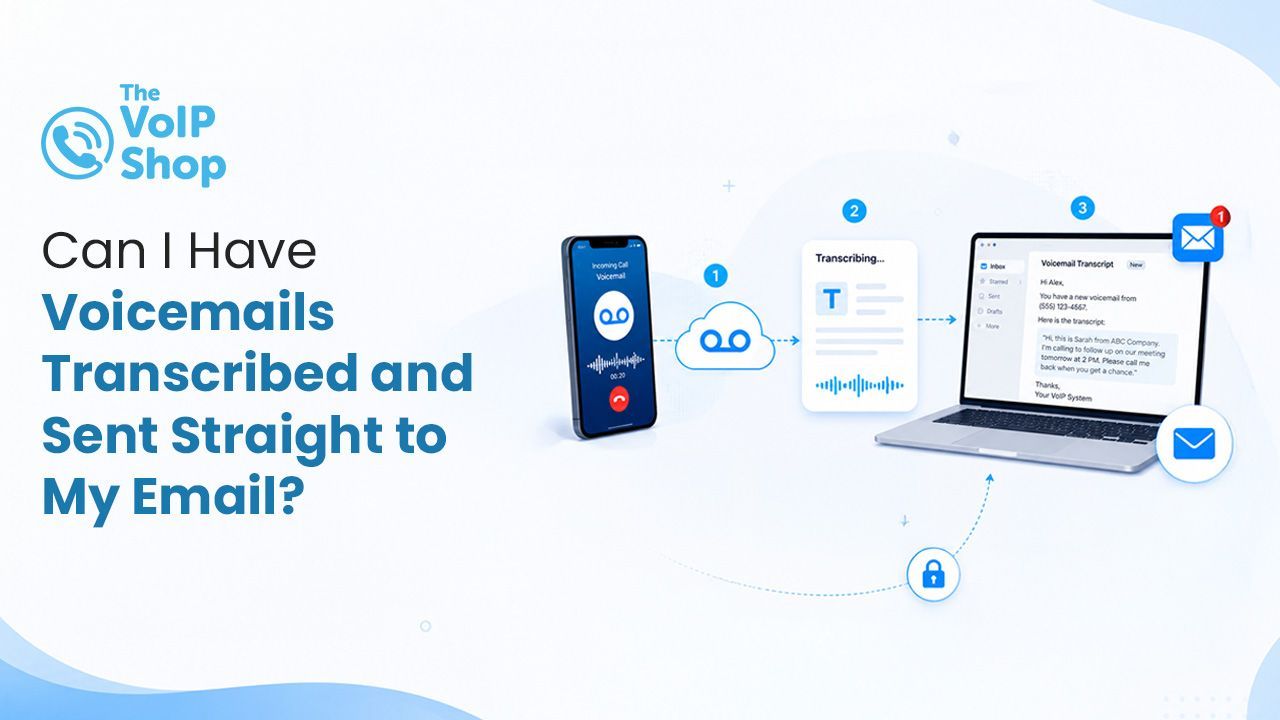
Yes. Modern VoIP systems can automatically convert voicemails into text and email them to your inbox within seconds of the call ending, with the original audio attached. The technology uses AI speech-to-text, and once it is set up during onboarding there is nothing you need to do. The transcript arrives in your inbox like any other email.

About the Author
What Is Voicemail-to-Email Transcription?
Voicemail transcription does what it sounds like. Your phone system listens to an incoming voicemail and automatically converts the spoken message into written text. The transcript is then emailed to you, and to other team members if you choose, within seconds of the call ending.
You can read the message on any device, including a laptop, tablet or smartphone, without ever needing to dial your voicemail box. No PINs, no playback, no scribbled notes.
How Does Voicemail Transcription Work?
| Step | What Happens |
|---|---|
| Caller leaves a voicemail | A caller leaves a voicemail on your business number or extension. |
| AI processes the audio | The system processes the audio using AI transcription. |
| Transcript is emailed | The transcript is formatted and emailed to your nominated inbox. |
| Audio is attached | The original audio recording is attached as well, so you can listen if needed. |
| Manage the message | You can reply, forward or file the email like any other message. |
Why Is Voicemail Transcription Useful for UK Businesses?
Speed of response. Callers who do not receive a prompt response often go to a competitor. With voicemail transcription, your team can scan inbound messages and prioritise callbacks even when they are in a meeting or between appointments, without waiting until they are back at their desk. For mobile-first teams, transcripts pair naturally with the mobile VoIP app.
Searchable records. Unlike audio recordings, text transcripts can be searched, forwarded and stored in your email system like any other communication. Need to find what a client said three weeks ago? Search your inbox.
Improved accessibility. For team members who are hard of hearing, or in environments where playing audio is not appropriate, such as a shared office, a hospital ward or a school, reading a transcript is far more practical than listening to a voicemail.
Better team visibility. Transcripts can be forwarded or copied to multiple people. If a client leaves a voicemail for someone off sick, a colleague can read it and follow up immediately, so no message gets lost.
Is Voicemail Transcription Accurate?
AI speech-to-text accuracy has improved significantly in recent years, but it is not perfect. Background noise, strong accents and poor call quality can all affect the result. That is why the original audio is always attached alongside the transcript. If anything reads oddly, you can listen back. For practical purposes, transcripts are accurate enough to scan, prioritise and act on without needing to replay the recording.
What Other AI Call Features Often Come Alongside It?
Once a system can transcribe voicemails, the same technology usually powers other call features:
Live call transcription. Recorded and live calls transcribed in real time, creating a full text record. Useful for compliance and record-keeping, customer service quality review, sales coaching and dispute resolution.
AI call summaries. Rather than reading a full transcript, AI generates a concise summary of each call with the key points, agreed actions and follow-ups, similar to having a note-taker on every call.
Searchable call history. All transcripts stored and searchable, so you can pull up what was discussed in any past call without relying on memory or notes.
For the wider security and compliance picture around call recording, see our VoIP security risks guide.
What Does It Look Like in Practice?
A busy GP surgery uses voicemail transcription on its cloud phone system. Outside core reception hours, patients leave voicemails. By 8am the next morning, the practice manager has already read every message in her inbox, including prescription requests, appointment queries and referral updates. She prioritises the urgent ones, and the team is actioning callbacks before the phones even open.
No missed messages. No time wasted listening to recordings. Just clear, actionable information when it is needed. This pairs well with after-hours and weekend call routing for full out-of-hours coverage.
What Should I Check Before Choosing a Provider?
Most modern cloud VoIP systems offer voicemail transcription, but the detail varies. Key things to check:
- Is it included as standard, or is it an add-on?
- How quickly do transcripts arrive after the call?
- Is the original audio attached to the email?
- Can you choose which extensions receive transcripts?
- Are there other AI call features included on the same plan?
Final Thoughts
Voicemail transcription is one of the simplest upgrades a business can make from a traditional phone system. It saves time, improves response speed, and creates a searchable record of every message. For any team that handles a high volume of voicemails, or that works partly outside the office, it pays back the small change quickly.
The VoIP Shop offers voicemail transcription as part of our cloud phone systems, backed by UK-based setup and support.
Get in touch to see how voicemail transcription could work for your business.
Written By | About the Author
Kully has over 15 years of experience in the VoIP and telecoms industry. Drawing on a background in telecoms sales and leadership, he provides expert, impartial advice on VoIP and cloud telephony solutions. As a lead author for The VoIP Shop, Kully helps businesses understand and adopt modern communication technologies