
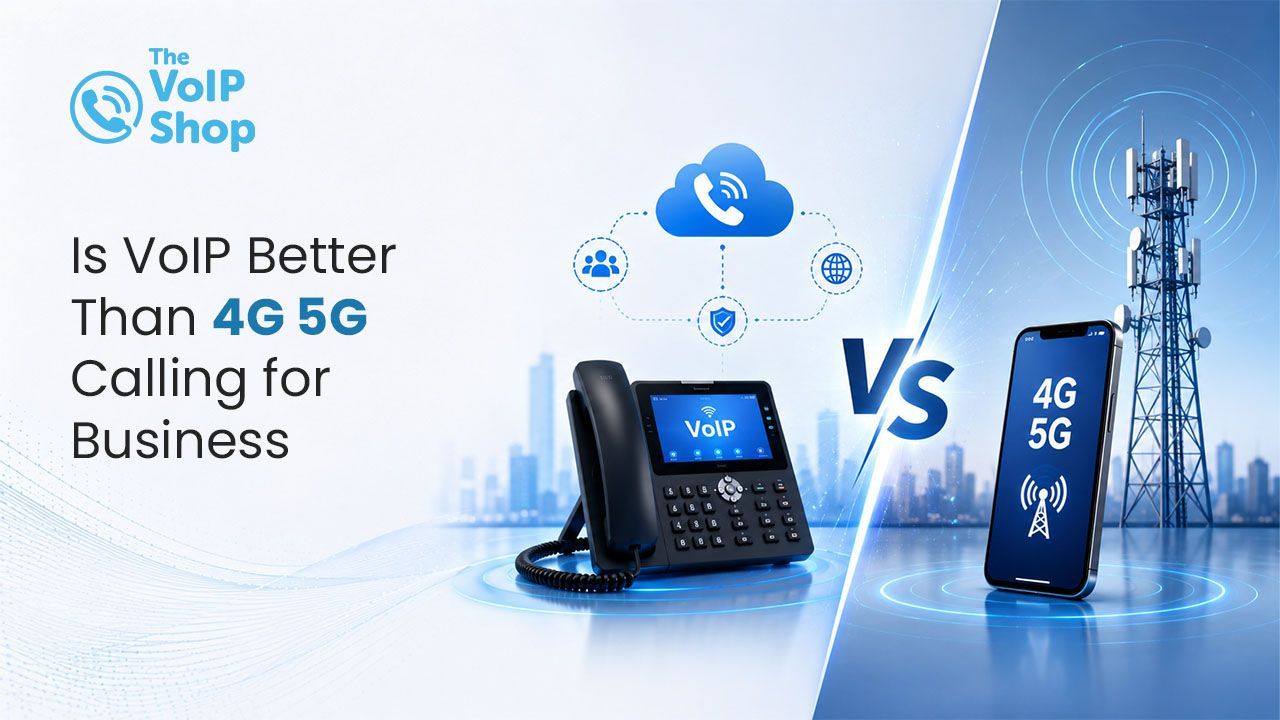
Is VoIP Better Than 4G/5G Calling for Business?
Yes. For most UK businesses with a reliable internet connection, VoIP is a better choice than 4G/5G calling. It offers lower operating costs, advanced business calling features, support for multiple devices, and easier scalability, while 4G/5G is best used as a backup or for highly mobile workers.

About the Author
How Do VoIP and 4G/5G Calling Compare?
Here is how the two options compare on the factors that matter most to a business:
| Factor | VoIP | 4G/5G |
|---|---|---|
| Cost | Lower, often bundled minutes and features | Per-line carrier charges, potential roaming costs |
| Business features | Auto-attendants, call queues, CRM integration, analytics | Limited to standard mobile features |
| Multi-device use | One number across the desk phone, app, and laptop | Tied mainly to a single SIM/device |
| Reliability | Depends on the internet connection quality | Depends on mobile signal coverage |
| Scalability | Add lines instantly through an admin portal | Requires new SIM contracts per line |
| Setup | Needs internet and, ideally, QoS configuration | Works wherever there's a mobile signal |
Why Do Businesses Choose VoIP?
Cost is usually the first driver. VoIP typically offers lower per-minute rates, no separate line rental per SIM, and bundled minutes or unlimited calling plans that are hard to match with mobile contracts across a whole team. As a guide, UK business VoIP plans typically start from around £10 per user per month, while a business mobile SIM with comparable minutes often costs £15 to £25 per line.
Beyond cost, VoIP brings business-specific call handling that mobile networks simply don't offer: automated call queues so customers aren't left waiting in silence, auto-attendants that route callers to the right department, voicemail-to-email so messages aren't missed, and detailed call analytics that help track response times and call volumes.
VoIP makes it easier to answer the same business number from a desk phone, a computer, or a mobile app, so a call can be picked up wherever an employee happens to be working, without giving out a personal mobile number. Scaling is simpler too: adding a new line is usually a case of assigning an extension through an online portal, rather than negotiating a new SIM contract.
VoIP also supports remote and hybrid working by allowing employees to answer calls from the office, home, or while travelling using the same business number. This creates a consistent experience for customers and improves business continuity.
When Might 4G/5G Still Be Useful?
4G/5G calling remains valuable in specific situations:
- As a backup during internet outages, so calls can still be made and received
- In locations with poor or unreliable broadband, such as remote sites
- For staff who are frequently out of the office without access to reliable Wi-Fi
- For urgent calls where any delay in a fallback system isn't acceptable
Many businesses run both in parallel: VoIP as the primary system for cost and features, with mobile calling as a fallback for staff on the move or during connectivity issues.
There is also a deadline in play. The UK's traditional phone network (PSTN) is being switched off in January 2027, and 4G/5G calling on its own is not a replacement path for a business landline number. VoIP is the route Openreach and providers are moving businesses to, so companies comparing the two today are usually choosing their post-switch-off system, not just a calling method.
What Should a Business Weigh Up Before Choosing?
The decision usually comes down to how reliable the internet connection is at each site, how many business features (call queues, CRM integration, reporting) are actually needed, and how many staff need to be reachable on a shared number versus a personal mobile line. Businesses with solid broadband and a need for professional call handling tend to benefit most from VoIP, while those with highly mobile teams in low-connectivity areas may lean more on 4G/5G.
In our own installations, the most common setup we deploy is VoIP as the primary system with 4G backup included on Gold Level support, so calls keep flowing during a broadband outage.
Can the Two Be Combined?
Yes, many VoIP providers offer mobile apps that let staff make and receive calls on the business number over 4G/5G when Wi-Fi isn't available, effectively combining the cost and feature benefits of VoIP with the reach of a mobile network.
Looking for a VoIP System for Your Business?
The VoIP Shop provides business VoIP systems designed to offer reliable call quality and advanced calling features at a lower cost than traditional mobile-only setups, with 5G backup available on Gold Level support. Book a free consultation and we'll compare the numbers against your current mobile contracts.
Written By | About the Author
Kully has over 15 years of experience in the VoIP and telecoms industry. Drawing on a background in telecoms sales and leadership, he provides expert, impartial advice on VoIP and cloud telephony solutions. As a lead author for The VoIP Shop, Kully helps businesses understand and adopt modern communication technologies